

 Medically Reviewed

Key Takeaways
- GLP-1 medications can slow digestion, which may contribute to constipation, bloating, cramping, and other GI symptoms.
- Fiber supplements may support regular bowel movements, but tolerance varies by fiber type and digestive sensitivity.
- Increasing fiber too quickly, especially without enough water, can worsen constipation or cause bloating.
- Whole foods should be the primary source of fiber when possible, with supplements used to fill practical gaps.
- Gentle, well-tolerated options may be better for GLP-1 users who already have stomach discomfort.
Most GLP-1 side effects are mild to moderate—but that doesn’t mean they aren’t uncomfortable or inconvenient. GLP-1s work their magic on weight loss in more than one way, including slowing the rate at which you digest and expel food.
The upside is feeling fuller, longer. The downside? For some GLP-1 users, gastrointestinal issues like cramps or constipation can occur. If you’re looking for relief from GLP-1 constipation, you need to know which fiber supplements can help move things along.
GLP-1 Constipation: How It Happens
GLP-1 medications delay gastric emptying. In plain English, these drugs slow your digestive system, stretching out the satiety and fullness you get from eating a meal.
However, studies tell us this gastrointestinal slowdown can, for some users, morph into gastroparesis—a condition in which the deep musculature in your stomach cannot physically move food the way it should.
Gastroparesis and constipation are not the same thing, but the data show a parallel relationship for GLP-1 users. Regardless, GLP-1s “commonly result in constipation as a side effect,” so say researchers in The American Journal of Gastroenterology.
Top 5 Best Fiber Supplements for GLP-1 Constipation
Dietary fiber has been touted as a means of smoothing out digestion long before GLP-1s came into vogue. Anyone with toilet troubles is asked, almost without fail, “How much fiber are you getting?”
It’s worth saying outright: Fiber really is that important for digestion. A 2022 systematic review and meta-analysis of fiber’s impact on constipation concluded that dietary fiber sources can have a “significant effect” on constipation, especially at higher-than-average doses (adding 10 grams or more per day to your standard intake).
The question then evolves from, “Should I take fiber on GLP-1s?” to, “What’s the best fiber supplement for GLP-1 users?”
Best Overall: PHGG (Partially Hydrolyzed Guar Gum)
In 2026, PHGG, or partially hydrolyzed guar gum—you may know it as Sunfiber—is an exciting new option for GLP-1 users. Why? It’s a low-FODMAP option.
FODMAP, or “fermentable oligosaccharides, disaccharides, monosaccharides, and polyols,” describes a collection of sugars that your small intestine struggles to properly absorb, according to Johns Hopkins Medicine.
Foods and supplements that score low on the FODMAP scale tend to go down easy and are more readily digestible, especially for those struggling with tummy issues already. PHGG, according to some clinical data, is tolerable even for chronic IBS sufferers.
Best for Sensitive Stomachs: Acacia Fiber
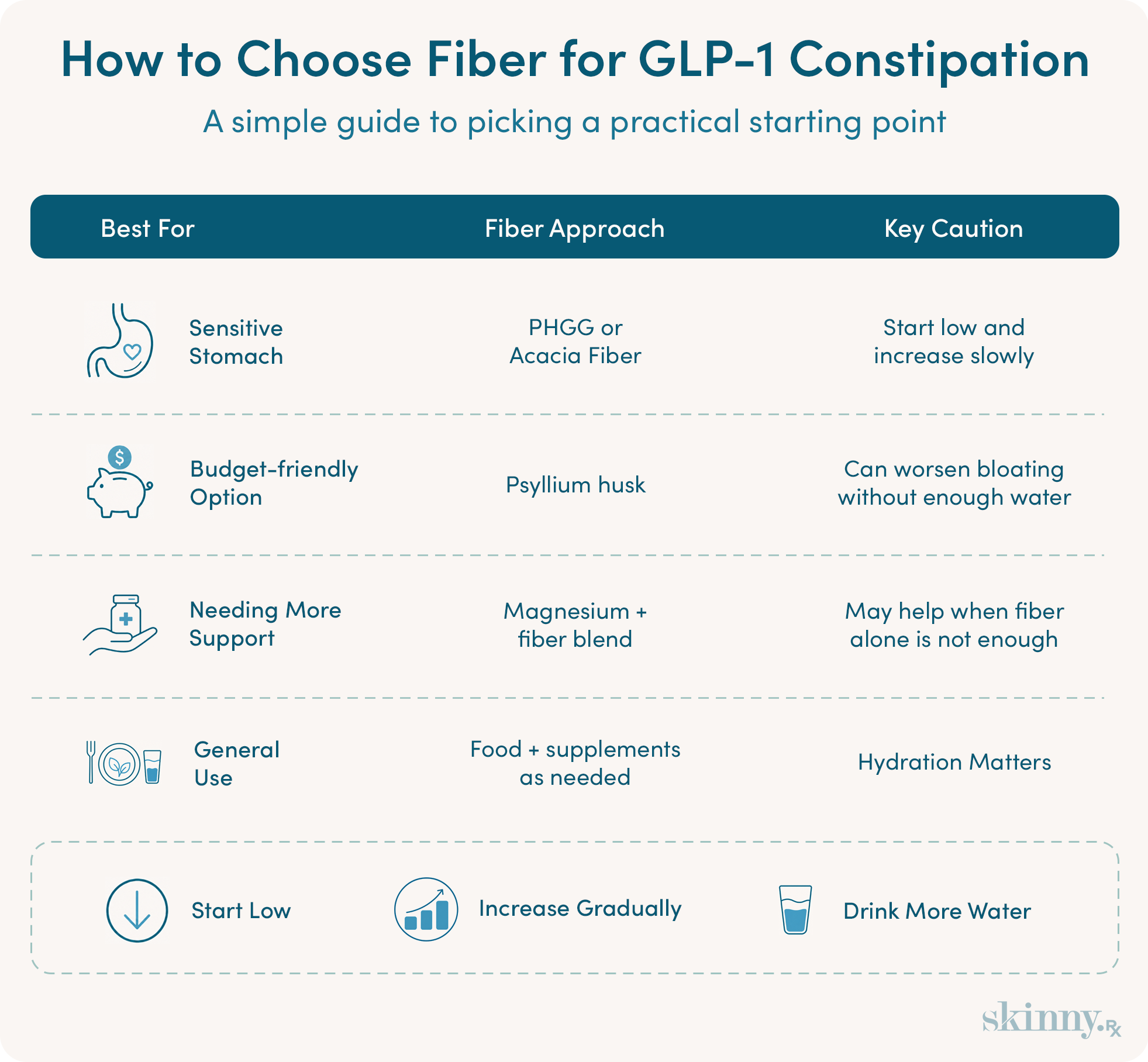
Some individuals are particularly prone to the worst of the gastrointestinal side effects that come with using a GLP-1. If you need to tread carefully but still want to improve constipation with a fiber supplement, acacia fiber is up your alley.
Trial data describe acacia fiber, which comes in gum form and can be mixed into both food and beverages, as “well tolerated”—other studies specifically highlight its ability to relieve constipation for those suffering from IBS.
For those needing to steer clear of gastrointestinal triggers at all costs, while still hitting their fiber quota for the day, acacia fiber is a solid pick.
Explore Personalized Weight Loss Options
Start with an online assessment to help a licensed clinician determine whether a prescription weight loss treatment, along with guided nutritional support, may be appropriate for you.
Best Budget Option: Psyllium Husk (With a Warning)
Health supplements can get expensive fast. If you’re shopping for a GLP-1 fiber supplement and need to mind your budget, psyllium husk is worth a look. The American College of Gastroenterology regards it as a frontline defense against symptoms like constipation.
However, while psyllium husk has the potential to remedy stomach issues, it can also worsen them. Psyllium tends to congeal after ingestion and, if you don’t consume plenty of water, can cause bloating and cramping.
Best “All-in-One”: Magnesium + Fiber Blends
You should tackle most health issues with a multi-pronged approach. When it comes to supplementation for constipation on GLP-1s, you can ensure you’re covering your bases by turning to a combination supplement with both magnesium and fiber.
Why? Pairing fiber with magnesium citrate or oxide has been shown to have a positive impact, especially in patients for whom fiber alone wasn’t cutting it.
How To Safely Add Fiber To Your Diet
Fiber can be a huge asset to your health and wellness, but you can definitely have too much of a good thing. Similarly to how you began your GLP-1 protocol by titrating from a conservative dose up to an amount that is uniquely therapeutic for you, you should also gradually ramp up your fiber intake—especially if you don’t get much or any from your standard diet.
Secondly, it is absolutely crucial to pair a fiber supplement (or high-fiber diet) with drinking more water. Increasing your fiber intake without hydrating is a bit like adding more cars to a traffic jam; you need water to smooth things over on the road, so to speak.
Beyond pills or powders, you can also ramp up your fiber intake by changing what you put into your grocery cart.
High-Fiber Foods for GLP-1 Users
GLP-1 users can generally grab the same high-fiber foods as non-users, but it pays to be mindful of how those foods may irritate an already-sensitive stomach. For example, some dried fruits have plenty of fiber but are challenging to digest.
You’ll also want to make sure you’re getting a mix of both insoluble (roughage, or physical food material that isn’t broken down) and soluble fiber (dissolves in liquid).
Bottom Line
Constipation on a GLP-1 is common, manageable, and not something you have to just push through. The right fiber supplement, paired with adequate hydration and a gradual ramp-up in intake, can make a meaningful difference.
If your stomach is sensitive, start with acacia fiber or PHGG and work your way up slowly. If budget is the priority, psyllium husk gets the job done as long as you drink enough water. And if fiber alone isn't cutting it, a combination of magnesium and fiber gives you a stronger foundation to work from.
Food first is always the right instinct. But supplements exist for a reason, and there is nothing wrong with leaning on one while your body adjusts to a new medication and a new way of eating.
The goal is consistency, not perfection. A little more fiber, a little more water, and some patience go a long way. If symptoms persist or worsen, loop in your physician. They can help rule out anything beyond run-of-the-mill GLP-1 constipation and point you toward the right solution for your specific situation.
Frequently Asked Questions
Explore Personalized Weight Loss Options
Start with an online assessment to help a licensed clinician determine whether a prescription weight loss treatment, along with guided nutritional support, may be appropriate for you.

By Jake Dickson, NASM-CPT, USAW-L2
Contributing Author
Jake holds a B.S. in Exercise Science from UNC Wilmington and began his career as a personal trainer and weightlifting coach. In recent years, he’s moved behind the page as a writer and editor, contributing hundreds of articles and being featured as a subject matter expert. Today, Jake’s goal remains the same: to empower people to change their lives by bringing heady scientific topics down to ground level.