

 Medically Reviewed

Key Takeaways
- GLP-1s may reduce overall food intake, making nutrient-dense choices more important when planning grocery purchases.
- Eating enough fruits and vegetables should come before deciding whether organic produce is worth the added cost.
- Lean cuts of beef, poultry, and other protein-rich foods can support nutrition goals without requiring premium labels.
- Labels like grass-fed, cage-free, and wild-caught may reflect differences in sourcing, welfare, or sustainability, but they do not guarantee better weight-loss results.
- Budget-friendly options like frozen produce, canned fish, sale items, and bulk purchases can still fit a healthy GLP-1 eating pattern.
GLP-1 medications are intended to treat obesity and work by suppressing appetite and slowing a meal’s transit time through the intestines. As a result, people on GLP-1s consume about 30-40% less energy than people who are not taking the medication.
For some people, being on a GLP-1 may translate into a lower food budget, as they spend less at the grocery store, eat less at restaurants, or have an alcoholic beverage less often than usual. When presented with the dizzying array of choices at the grocery store, you can evaluate all the options and decide whether the higher-ticket items are worthwhile.
It is important to note that you can follow a healthy dietary pattern regardless of whether you choose the more budget-friendly or the higher-priced options. Certain categories of food, especially produce, beef, poultry, eggs, and seafood, have differences in their nutritional value, environmental impact, or animal welfare.
Ultimately, you can be well-informed in your food purchasing decisions and make the best choice for your health and your wallet, especially when taking GLP-1 medications.
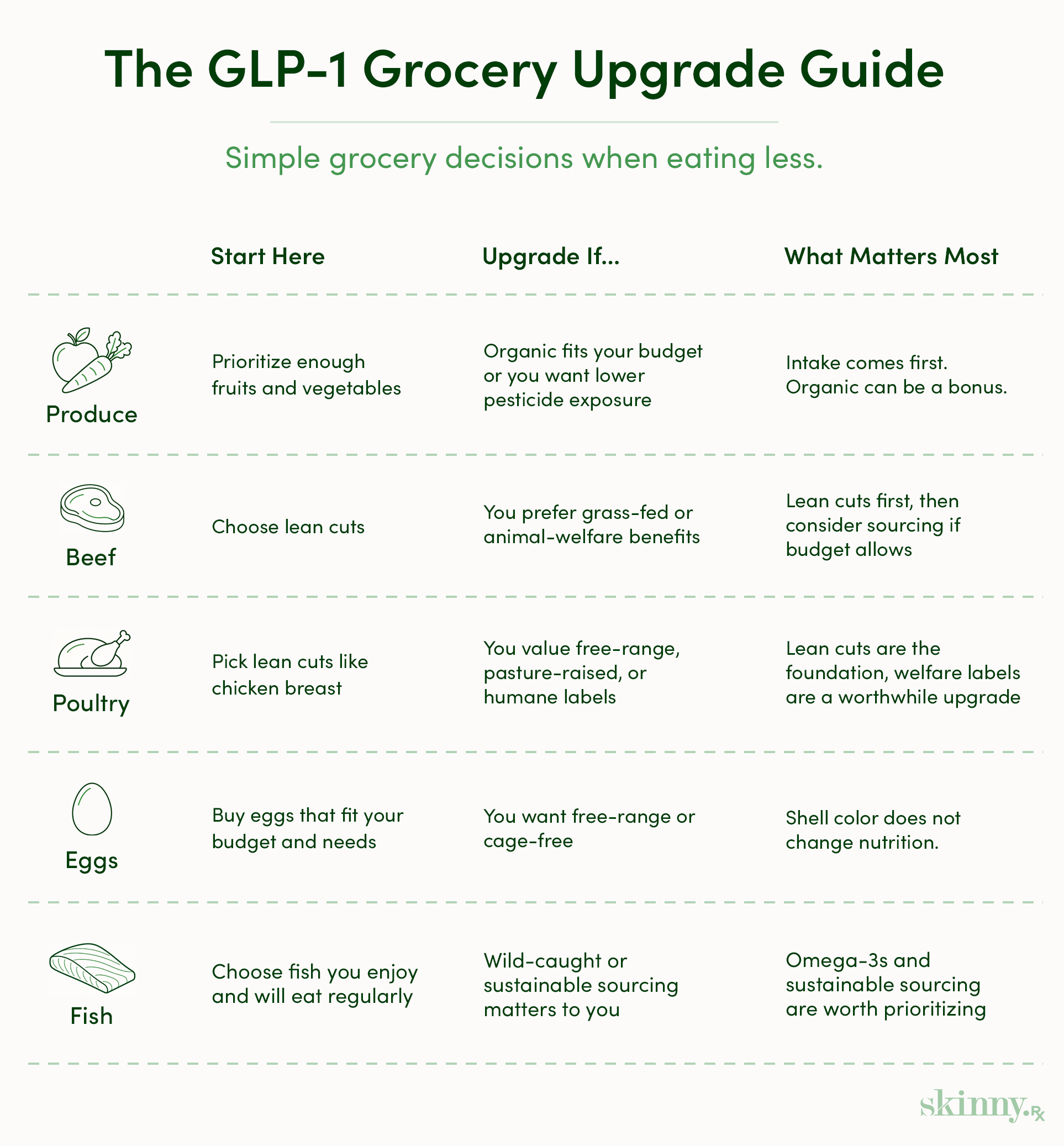
Vegetables and Fruits: Organic or Conventional?
When surveying the produce section, you may be wondering whether purchasing organic fruits and vegetables is worth the extra cost. The reality is that most Americans do not consume the recommended amount of vegetables and fruits daily, regardless of how they were grown.
The Dietary Guidelines for Americans 2025-2030 recommend having at least 3 servings of vegetables and 2 servings of fruit daily on a 2,000-calorie dietary pattern, and eating a variety of colorful, nutrient-dense options.
So, your first question should be: Am I getting enough vegetables and fruits in my diet? If the answer is no, then start by prioritizing more of these key food groups in your diet. If the answer is yes, then you may be ready to consider the organic or conventional options in your produce aisle.
How Conventional and Organic Growing Differ
Conventionally grown produce is grown using standard farming methods, which may include synthetic fertilizers, pesticides, herbicides, or genetically modified organisms.
In contrast, organic produce must be grown in soil that has had no synthetic fertilizers or pesticides for at least 3 years prior to harvest. The United States Department of Agriculture (USDA) closely regulates the use of organic labeling on food packages.
When Organic Offers Added Benefits
Both organic and conventionally grown vegetables and fruits are healthy options that offer key nutrients, including fiber, antioxidants, vitamins, and minerals. However, organically grown produce may be slightly higher in some nutrients, though this varies widely depending on the food in question, the growing conditions, and how it was prepared.
Organically grown produce also offers the added benefit of reducing pesticide intake. Though the impact of organically grown versus conventionally grown food intake on human health is nuanced, research suggests that organic food intake may generally decrease disease risk.
Some consumers may also prefer organic practices for their beneficial impact on the environment, including resource cycling, ecological balance, and biodiversity conservation.
Produce Preparation Tips and Budget Hacks
When preparing vegetables and fruits in your own kitchen, wash them thoroughly under cool, running water to remove dirt, germs, and other chemicals. Removing the outer leaves of conventionally grown leafy vegetables (e.g., cabbage) can also reduce pesticide intake.
In terms of budget hacks, look for organic frozen produce, which is typically much less expensive than fresh produce and still provides all of the key nutrients. You can also aim to purchase vegetables and fruits that are in season and will often be more affordable.
Shopping at Your Local Farmers Market
It’s also important to note that a grower may utilize organic farming practices, yet not have received certification from the USDA. This is often the case at local farmers' markets where farmers are growing on smaller scales.
To find a farmers' market near you, check out the USDA’s National Farmers Market Directory. This tool can help you locate farmers' markets, community supported agriculture (CSA) programs, food hubs, or markets located directly on a farm.

Explore Personalized Weight Loss Options
Start with an online assessment to help a licensed clinician determine whether a prescription weight loss treatment, along with guided nutritional support, may be appropriate for you.
What to Look for When Buying Beef
The beef section of your grocery store may also be head-spinning. Start by choosing fresh or frozen lean cuts of beef, such as a sirloin steak, top loin steak, chuck shoulder, or eye of round.
These options are low in total fat, including saturated fat, which the Dietary Guidelines for Americans 2025-2030 recommends limiting. Fresh cuts of beef will be lower in sodium and fat than processed meats, such as bacon, sausage, or salami.
Grass-Fed or Grain-Fed?
Most beef cattle in the United States are conventionally raised and fed a high-energy, grain-based diet made from corn in soy. In contrast, grass-fed beef cattle are offered a natural diet of various grasses.
In terms of nutritional differences, grass-fed beef naturally contains lower levels of total fat and saturated fat compared to grain-fed beef. Grass-fed beef also has higher levels of omega-3 fatty acids, which are essentially fatty acids also found in fatty fish, nuts, and seeds.
Environmental Impact of Beef
The environmental impact of your steak may also be an important consideration when surveying your butcher shop offerings. Meat production accounts for over 30% of methane emissions and contributes to deforestation.
Many options are available at your butcher, including organic, grass-fed, and antibiotic- and growth-hormone-free meat. The answer to which option is best is fairly nuanced. Grass-fed beef has the benefit of improved animal welfare, and meat raised without antibiotics or growth hormones can help slow antimicrobial resistance in humans and animals. However, these options can sometimes have more of an environmental impact due to a longer lifespan and greater methane gas emissions.
Eating less meat overall, regardless of how it was raised, helps ease food-related greenhouse gas emissions.
Making Sense of Poultry Labels and Living Conditions
In the poultry aisle, aim to select fresh or frozen lean cuts, such as the breast of chicken or poultry. The options in your poultry aisle may vary based on improved living conditions for the hens and what the hens were fed.
Free-Range or Pasture-Raised?
Most poultry in the United States is raised traditionally in climate-controlled growing houses and fed a high-protein diet. Free-range birds are raised in growing houses with access to the outdoors, while pasture-raised birds are raised outdoors using movable enclosures located on grass.
Both types may be fed a high-protein diet, yet have access to grass, grubs, and worms. Compared to traditionally raised birds in poultry houses, those with access to the outdoors tend to be overall healthier.
In terms of nutritional value, they also tend to be lower in fat and higher in protein, zinc, and iron.
Conventional or Humanely Raised?
The growing conditions for conventionally raised poultry raise questions regarding animal welfare, biosecurity, and antibiotic resistance. Though the USDA does not regulate humane labeling, you may see labeling by independent organizations such as Human Farm Animal Care or Animal Welfare Approved.
These signals that animals were raised under humane growing conditions, allowed natural behaviors such as grazing or dust bathing, and fed nutritious diets without antibiotics or hormones.
Decoding the Egg Carton: Labels, Shell Color, and Hen Welfare
The price of a dozen eggs often feels like a pulse check on overall prices at the grocery store, spanning from a few dollars to the double digits. These prices reflect differences in how the hens were raised, the color of their shells, and the nature of their diets.
Free-Range or Cage-Free?
Eggs labeled as free-range are laid by hens that are free to roam in indoor houses, have access to fresh food and water, and can access an outdoor area. Similarly, cage-free eggs are produced by hens that are able to roam in indoor houses and have access to fresh food and water, but do not necessarily have access to the outdoors.
In terms of the nutritional value, hens with access to the outdoors or fed specially designed chicken feed may produce eggs with higher levels of omega-3 fatty acids, but do not differ in terms of other nutrients, such as vitamin A, vitamin E, or dietary cholesterol, when compared to eggs from traditionally raised hens.
Brown or White?
The egg options at your grocery store are typically brown or white. At your farmers' market, you may even see eggs that are pink, light blue, or purple. Though there is a perception that brown eggs are healthier, the truth is that the color of the shell differs with the breed of hen, but does not indicate the nutritional value of the eggs inside.
Vegetarian, Non-GMO, or Humanely Raised?
Though hens are not vegetarians, they are sometimes fed a vegetarian diet, which indicates their feed contains no animal byproducts. When allowed to roam, hens will naturally eat grubs and worms.
Next, non-GMO labeling indicates that hens were fed a diet that did not contain GMO ingredients. As with poultry options, you may see labeling on egg cartons from independent organizations such as Human Farm Animal Care or Animal Welfare Approved.
Choosing Fish for Nutrition and Sustainability
The Environmental Protection Agency regulates fisheries in the United States. Choices in the seafood aisle often focus on how it was sourced—most commonly whether it’s wild-caught or farm-raised.
The nutritional profile of wild-caught or farm-raised seafood depends on the type. For example, farm-raised salmon are typically higher in total fat compared to wild-caught salmon, with a lower proportion of essential omega-3 fatty acids. In terms of environmental impact, seafood can be raised sustainably under both wild-caught and farming conditions, depending on the fishery.
The National Oceanic and Atmospheric Administration (NOAA) is a government agency that updates a searchable tool on sustainable seafood profiles.
Bottom Line: Taking It One Bite at a Time
Navigating the grocery store on a GLP-1 medication doesn't have to feel overwhelming. Whether you're comparing labels at the butcher counter or weighing organic versus conventional in the produce aisle, making intentional choices is a meaningful step in the right direction.
No single food decision will make or break your progress. What matters most is the overall pattern on your plate. Prioritizing vegetables and fruits, lean cuts of meat and poultry, quality eggs, and sustainable seafood can help build a dietary pattern that works alongside your medication.
You don't need to buy the most expensive option in every aisle to eat well. Budget-friendly choices like frozen organic produce or canned wild salmon can be just as nourishing as their premium counterparts. Small, thoughtful choices add up over time, and every step toward eating with intention is worth celebrating.
Frequently Asked Questions
Explore Personalized Weight Loss Options
Start with an online assessment to help a licensed clinician determine whether a prescription weight loss treatment, along with guided nutritional support, may be appropriate for you.

By Whitney Linsenmeyer
Assistant Professor of Nutrition and Dietetics
Whitney Linsenmeyer, PhD, RD, is an Assistant Professor of Nutrition and Dietetics at Saint Louis University and a National Spokesperson for the Academy of Nutrition and Dietetics with expertise in fad diets, culinary nutrition, and transgender health. Her research focuses on gender-affirming nutrition care, and she brings a joy-first approach to food science and eating behavior.