
 Medically Reviewed

Key Takeaways
- Feeling cold on semaglutide is usually harmless and may subside, but persistent chills, weakness, dizziness, or changes in circulation should be discussed with your medical provider.
- Weight loss can reduce body fat insulation, making it harder to retain warmth.
- Eating less may reduce the heat your body produces through digestion.
- GLP-1s may affect temperature sensitivity through the hypothalamus, the brain region involved in temperature regulation.
- Protein intake, regular movement, and practical warming strategies can help manage day-to-day coldness.
If you’re cold on semaglutide, the oft-parroted and tiresome “just put on a sweater” advice probably rings hollow by now. “Yeah, I’ve tried that,” you say to yourself.
Here’s the deal: Ozempic, Wegovy, and other GLP-1s don’t necessarily make you cold. But regular chills are, in a way, a side effect of a side effect. There are three primary reasons why you might feel colder than usual while on semaglutide.
Here’s how it works, and what to do about it.
Cold on Semaglutide: How the “Chill” Happens
Semaglutide has a host of side effects, most of which are mild, moderate, and manageable. That said, people don’t always talk about the downstream consequences of long-term GLP-1 use and the weight loss that comes with it.
If you’re feeling cold on semaglutide, it’s likely due to the weight loss you’ve achieved in concert with the medicine—but the drug itself plays a role, too.
There’s a distinction to be made between the two kinds of coldness people typically experience. Feeling “the chills” that travel from head to toe during the onset of a fever or flu, and extremity coldness, where the ends of your limbs feel colder than your head or torso. The “chill” generally describes the latter.
The Hypothalamus Connection
Semaglutide affects the hormone GLP-1 in the brain. In action, semaglutide influences how different regions of your brain communicate signals like hunger, satiety, or cravings. But studies tell us it also affects the hypothalamus—the region in your brain responsible for perceiving and regulating core temperature.
The exact mechanism is unclear, GLP-1s interact with brain pathways involved in appetite and autonomic regulation, and might be changing how you perceive sensations like warmth and cold, potentially making you more sensitive than you’d otherwise be.
Feeling cold does not necessarily imply reduced core thermogenesis. Preclinical studies suggest GLP-1 receptor signaling can modulate sympathetic outflow and peripheral thermoregulatory responses, although direct human evidence remains limited.
In some cases, autonomic effects such as increased peripheral vasoconstriction may make the hands and feet feel colder even without a major change in core body temperature.
Loss of Body Fat
Beyond the brain, semaglutide is also a potent weight loss agent. If you’re early into your first-ever weight loss journey, you’re likely running into a number of unexpected “side effects,” cold included.
Although considered aesthetically undesirable by some, body fat, or adipose tissue, plays an important role as an insulator and protector of our internal organs.
Fat helps conserve body heat the way a thermos keeps your coffee hot. Losing body fat literally thins the barrier between your internal climate and the weather outside.
The Thermic Effect of Food
Semaglutide encourages weight loss by discouraging you from eating, creating a calorie deficit—a gap in your body’s “balance sheet” between the energy you bring in and the energy you spend.
Calorie deficits are essential for weight loss, but reducing how much you eat also dampens your metabolic furnace. Physically eating and digesting food burns energy as heat; science calls it the thermic effect of food, and researchers say it “increases linearly with caloric intake, independent of leanness or obesity.”
Put simply, the more you eat, the more heat you produce processing that food. If you’re eating less on Ozempic, your metabolic furnace doesn’t have to work as hard.

Feeling cold on semaglutide isn’t usually a sign that something is wrong; it’s often a sign that something is working. You’re losing insulation, eating less, and shifting your metabolism all at once. The key is recognizing the signal without overreacting.
–
Dr. Sajad Zalzala, Board-certified Family Medicine Physician and Medical Advisor at SkinnyRx
Key Takeaways
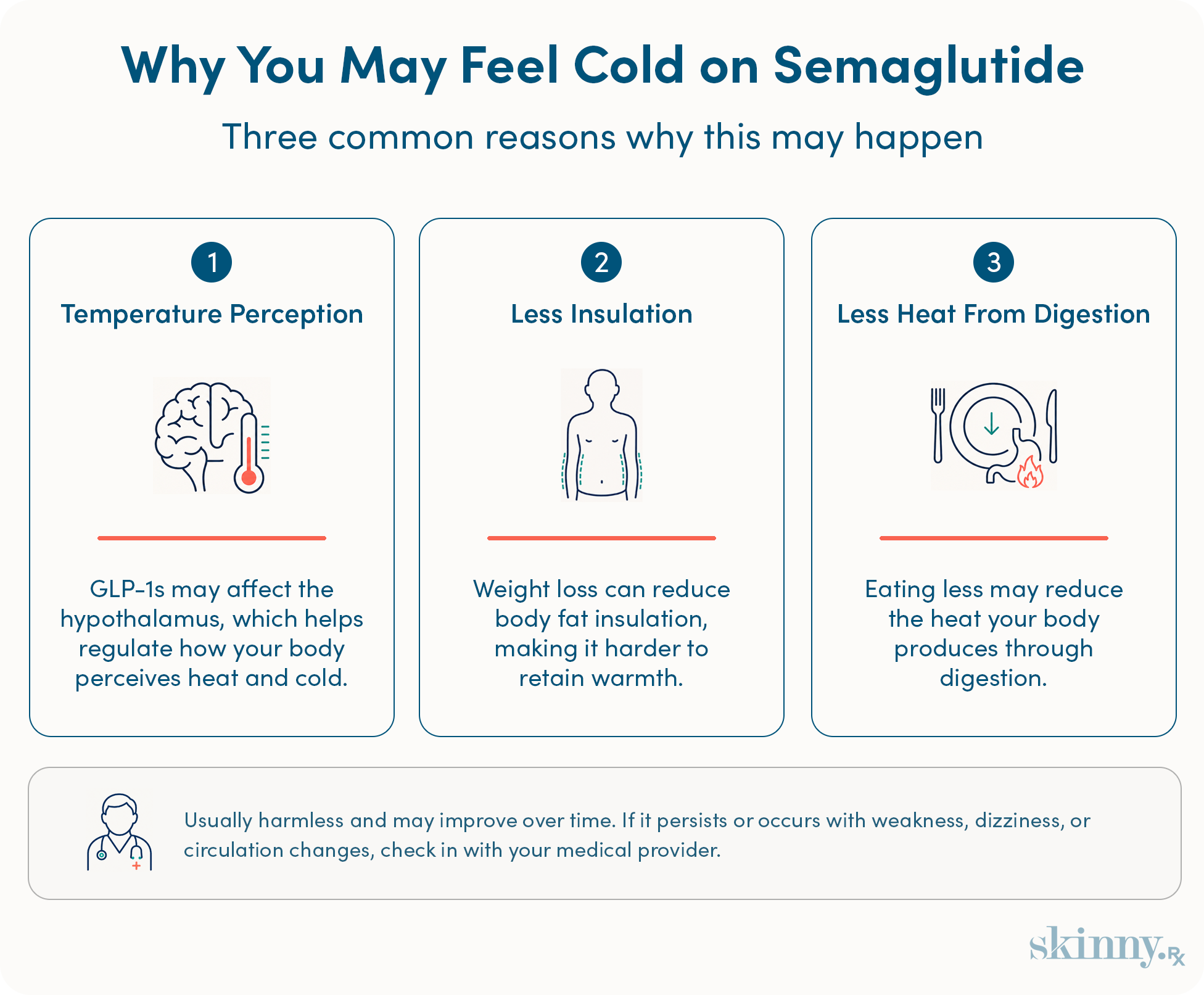
- GLP-1s affect the hypothalamus, which is responsible for regulating your perception of heat and cold.
- Losing body fat removes insulation that helps conserve heat.
- Eating and digesting food is an energy-intensive process that creates heat. If you’re eating less, that internal fire doesn’t need to burn as brightly.
When to Seek Medical Attention
All told, feeling cold on semaglutide is an inconvenient but typically harmless side effect of GLP-1-related weight loss. However, some situations may require medical attention. One worth paying attention to is nutritional depletion.
GLP-1s can, at times, dramatically reduce the amount of food you’re eating. While that’s great for losing weight, it also means you’re getting fewer essential vitamins and minerals—iron in particular.
On the vitamin front, studies have shown that not getting enough vitamin B12, for instance, can contribute to chronic chills.
Whether by diversifying your meals or turning to a multivitamin supplement, it’s good practice, whether you’re using a GLP-1 or not, to ensure you’re hitting the smaller nutritional benchmarks, too—they’re just as important.
How To Stay Warm On Semaglutide
If you’re feeling cold on semaglutide, the medication itself isn’t necessarily to blame. Instead of pointing fingers, it’s better to be productive and look for solutions. You can remedy chronic coldness to a degree in the kitchen, but there are more practical solutions as well.
Nutrition
Back to the thermic effect of food: Protein, one of the three primary macronutrients, has the highest thermic effect. Your body has to work harder to break down and utilize protein than it does for carbs or fat.
Protein also helps preserve muscle mass, which is a highly relevant concern for GLP-1 users in steep caloric deficits. Eating more protein hits two birds with the same stone; your body will have to crank its digestive furnace harder, and you’ll hold onto more valuable muscle tissue.
It sounds counterintuitive, but eating cold foods and drinking icy water may help slightly, too. Some limited data have compared drinking room-temperature water against chilled water and found a “small thermogenic response,” but it’s nothing worth writing home about.
You may also consider adding an electrolyte supplement to your daily water intake. Evidence is limited, but some case studies suggest that electrolyte imbalances can help alleviate acute chills.
Movement
If you’re feeling cold on your GLP-1, the best thing you can do—and not just for heating up—is exercise. In health & fitness, warm-ups are a crucial, and literal, aspect of workouts. Easy but intentional movement raises core temperature.
This doesn’t mean you need to sweat it out on the treadmill, you might just need to get up and go for a short, brisk walk.
Technology
If motion isn’t on the table, there are several other options to try to address coldness with semaglutide. A brief stint in a sauna will elevate your core temperature while you’re inside, but the benefits are hardly lasting and tend to dissipate within an hour or so—sooner if you move from the sauna to a chilly environment right after.
If you don’t have access to a sauna and need to warm up while sitting or lying down, choose clothing meant to insulate heat, such as wool, down, or fleece, or technical fabrics like Gore-Tex.
Bottom Line
Feeling cold on semaglutide is frustrating, but it makes sense once you understand what is happening. Your body is eating less, losing fat, and recalibrating how it perceives temperature. None of that is cause for alarm.
The fixes are mostly practical. Eat enough protein, keep moving, and make sure you are not falling short on key nutrients like B12. Those three things alone address the most common drivers of coldness on a GLP-1 and come with benefits that go well beyond just warming up.
If the coldness is persistent, severe, or accompanied by other symptoms, it is worth a conversation with your physician. Ruling out a nutritional deficiency or circulation issue is a reasonable and easy first step.
For most people, the Ozempic chill is a temporary and manageable part of the weight loss process. The goal is not to fight it, but to work with your body while it adjusts.
Frequently Asked Questions
Explore Personalized Weight Loss Options
Start with an online assessment to help a licensed clinician determine whether a prescription weight loss treatment may be appropriate for you.

By Jake Dickson, NASM-CPT, USAW-L2
Contributing Author
Jake holds a B.S. in Exercise Science from UNC Wilmington and began his career as a personal trainer and weightlifting coach. In recent years, he’s moved behind the page as a writer and editor, contributing hundreds of articles and being featured as a subject matter expert. Today, Jake’s goal remains the same: to empower people to change their lives by bringing heady scientific topics down to ground level.