

 Medically Reviewed

Key Takeaways
- Switching between semaglutide and tirzepatide is not a dose-for-dose conversion, and no FDA-approved equivalency exists.
- Most patients restart at a low introductory dose when switching GLP-1 medications to limit side effects.
- A short washout period may be recommended between medications due to their long half-lives.
- Gastrointestinal side effects can return during the transition, especially when starting or increasing doses.
- Weight loss and blood sugar effects often take several weeks to become noticeable after switching.
Thinking about switching from semaglutide to tirzepatide, or vice versa? You’re not alone. Around one in ten people switch from one GLP-1 medication to another within the first year of treatment, according to some estimates.
Let’s explore why people switch from Wegovy to Zepbound®, and what you can expect when transitioning GLP-1 medications.
Why Patients Switch: The Three Main Drivers
There are three main reasons why people might switch from Ozempic to Mounjaro®, or Wegovy to Zepbound®:
- Their weight loss has stalled on their current GLP-1
- They’re experiencing intolerable side effects
- Their insurance coverage has changed
Let’s take a closer look at each of these.
Breaking the "Plateau" (Efficacy Differences)
If your weight loss seems to have screeched to a halt, you may have run into a weight loss plateau. Plateaus are a normal part of any weight loss journey, but that doesn’t make them any less frustrating. Making more dietary changes or intensifying your workouts can help, as can switching from semaglutide to tirzepatide.
In head-to-head trials, tirzepatide consistently produces significantly more weight loss than semaglutide. For example, a 72-week study of adults with obesity or overweight found that people lost 20.2% of their body weight on tirzepatide vs. less than 14% on semaglutide.
Tirzepatide also beats semaglutide when it comes to blood sugar control. Research shows that, when compared to semaglutide, tirzepatide reduces blood sugar levels by an additional 0.15%– 0.45% So if your HbA1c levels haven’t gone as low as you and your provider had hoped on one medication, it might be time to consider making the switch to another one.
Managing Intolerable Side Effects
Semaglutide and tirzepatide are both known for causing gastrointestinal side effects. Here’s a quick look at the most common side effects for each medication, as reported by at least 5% of people in clinical trials:
For some people, these side effects can become disruptive, leading them to seek an alternative medication.
Research does show that side effects are usually more common with tirzepatide — especially at higher doses — but that’s not always the case. In other words, your mileage may vary.
Insurance Coverage and Availability Issues
Sometimes, a medication is working perfectly fine, but your insurance coverage (or lack thereof) drives the change. Ozempic, Wegovy, Mounjaro®, and Zepbound® can all cost upwards of $1,000 out-of-pocket, so it’s worth trying the one your insurance covers.
The U.S. Food and Drug Administration (FDA) has approved the following GLP-1 medications for different conditions, which can also dictate insurance coverage. Here’s a quick overview:
Sometimes, one or more of these medications may be in shortage, making your Rx difficult to fill at the pharmacy. Thankfully, most GLP-1 shortages have been resolved since early 2025, but a shortage can also drive people to switch from tirzepatide to semaglutide, or semaglutide to tirzepatide.
The Science: GLP-1 vs. GIP/GLP-1 Dual Agonists
The research shows that tirzepatide outperforms semaglutide at both weight loss and blood sugar control. The reason why has to do with how the medications work in your body.
Semaglutide (The Single Agonist) Explained
Semaglutide is a single GLP-1 agonist. It works by targeting the receptors of glucagon-like peptide-1 (GLP-1), a gut hormone involved in regulating your digestion, appetite, and blood sugar levels.
Tirzepatide (The Dual Agonist) Explained
Unlike semaglutide, tirzepatide is a dual GIP/GLP-1 agonist. It targets the receptors of GLP-1 as well as another hormone called glucose-dependent insulinotropic polypeptide (GIP).
Targeting both types of receptors enhances tirzepatide’s effects on digestion and blood sugar, potentially explaining why it can be more effective than semaglutide.
Why Tirzepatide Often Shows Greater Weight Loss
Thanks to its dual-targeting ability, tirzepatide produces more weight loss than semaglutide. For example, a study of over 18,000 adults directly compared the weight loss effects of tirzepatide vs. semaglutide. After a year, the people taking tirzepatide were:
- Nearly twice as likely to lose 5% of their body weight.
- More than twice as likely to lose at least 10% of their body weight.
- More than three times as likely to lose at least 15% of their body weight.
Another study compared the weight loss effects of the highest doses of tirzepatide and semaglutide. After 72 weeks, people taking tirzepatide lost over 20% of their body weight and shaved over 7 inches off their waistlines. By comparison, people taking semaglutide lost nearly 14% of their body weight and about 5 inches off their waistlines.
How the Switch Works: Dosing and Protocols
Switching from semaglutide to tirzepatide should be done under the supervision of a licensed healthcare provider. They can prescribe the best dose for you based on your health goals and previous response to GLP-1s, which may be a starting dose of 2.5 mg or 5 mg of tirzepatide.
The "Start Low" Approach (Resetting to Introduction Doses)
Semaglutide and tirzepatide both follow titrated dosing schedules, where healthcare providers prescribe a low starting dose and gradually increase from there based on your response to the medication and tolerance for side effects.
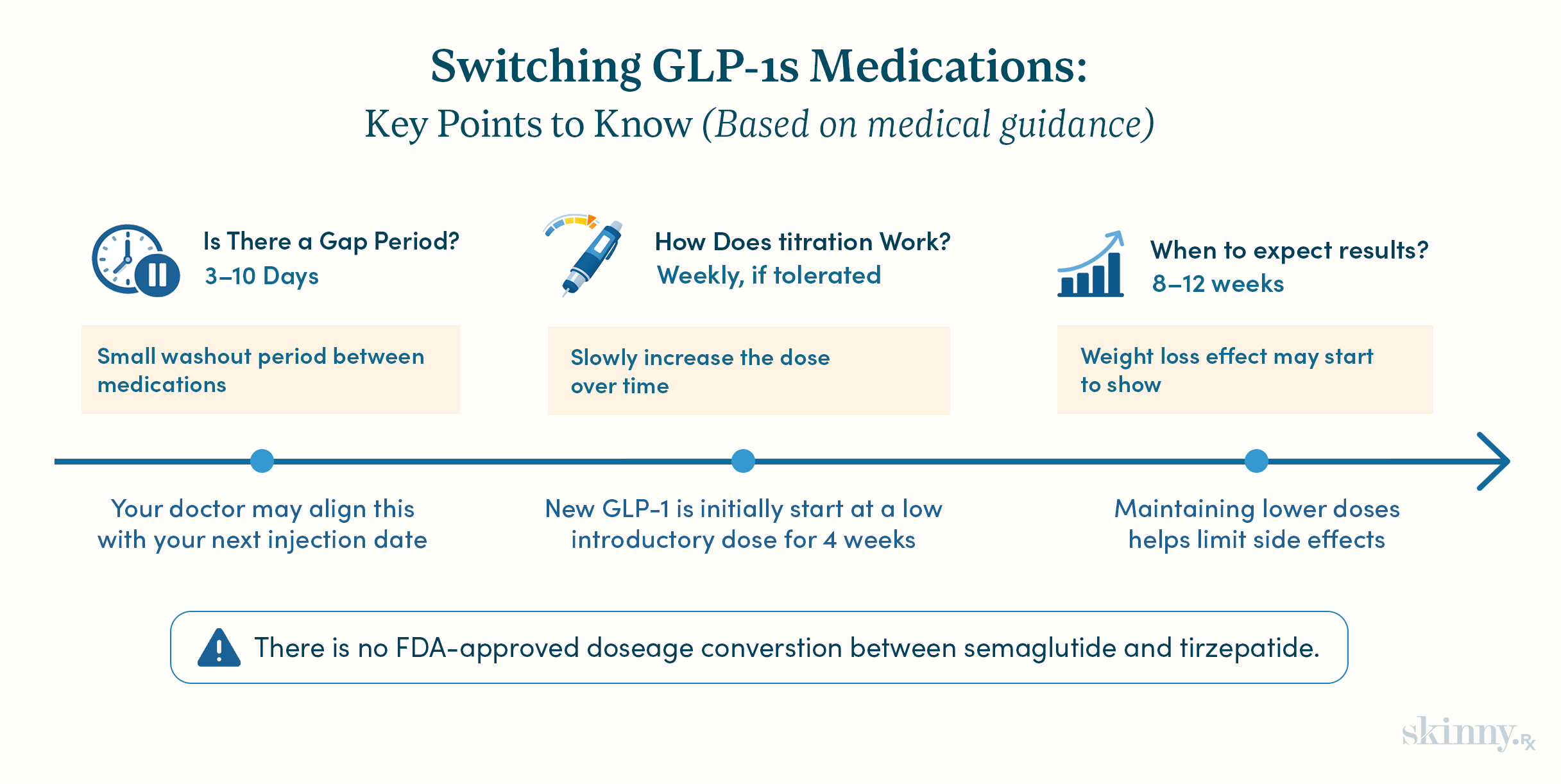
When switching from semaglutide to tirzepatide, your provider may recommend you follow the standard titration schedule and start at the lowest 2.5 mg dose of tirzepatide. Starting at the lowest dose gives your body time to adjust to the new medication and may reduce side effects.
The "Lateral" or "Equivalent" Transfer (Risks and Benefits)
Some studies have found that switching to a higher 5-mg dose of tirzepatide can be just as well-tolerated as the lower 2.5-mg dose. So if you’ve handled GLP-1 side effects well in the past, your healthcare provider may have you “leapfrog” ahead to the 5 mg dose.
Do You Need a Washout Period? (Clearing the System)
Because tirzepatide and semaglutide both have long half-lives (5 or 7 days, respectively), healthcare providers may recommend a short “washout” period before starting the new medication.
Generally, this washout period lasts 3–10 days between doses. In most cases, you may be able to start your new medication on your regular dosing day, 1 week after your last dose of the old medication.
If you still have remaining doses of your old medication, do not take them and dispose of them in your medical sharps container. Different GLP-1s should not be used at the same time.
Doctor-Guided Medical Weight Loss
Learn how prescription GLP-1 medications like semaglutide or tirzepatide may support weight loss when guided by a licensed medical provider and tailored to your health history.
Dosage Conversion Guide (General Estimates)
Semaglutide and tirzepatide are different medications with different dosage strengths. A high dose of semaglutide does not automatically equal the highest dose of tirzepatide, and there is no official FDA-approved dosage conversion chart.
Your healthcare provider will determine the appropriate dosage for you based on your current dosage and tolerance for side effects. Generally, healthcare providers start at a lower dosage to avoid severe nausea or gastrointestinal distress.
Moving from Semaglutide (2.4mg) to Tirzepatide
If you are switching from Wegovy to Zepbound®, your healthcare provider will likely have you start at a lower dose, usually 2.5 mg or 5 mg weekly. From there, they may increase your dosage every 4 weeks until you reach an effective maintenance dosage.
Moving from Tirzepatide to Semaglutide
If you are switching from tirzepatide to semaglutide, your healthcare provider will likely have you start at a lower dose of semaglutide, usually 0.25 mg or 0.5 mg weekly. From there, they may increase your dosage every 4 weeks until you reach an effective maintenance dosage.
The maximum dosage of Ozempic is 2 mg weekly and the maximum dosage of Wegovy is 2.4 mg weekly.
What to Expect During the Transition
When transitioning GLP-1 medications, you can expect to experience some side effects, and a possible slowdown in your weight loss as your body adjusts to the new medication.
Side Effect Flare-Ups (Nausea, GI Issues)
Remember those side effects you experienced back when you started semaglutide or tirzepatide? Get ready to experience them again — and possibly even new ones. GLP-1 side effects are most intense when increasing your dose or starting the medication, and even though you’re transitioning between medications, you’re technically starting one for the first time.
The most common side effects when transitioning GLP-1 medications include:
- Mild to moderate GI distress
- Diarrhea
- Constipation
- Nausea
If certain techniques helped you manage the side effects last time, feel free to use those again. You can also follow this general advice for managing side effects on GLP-1s:
- Eat smaller portions, more often, and more slowly
- Only eat when you’re hungry, and stop when you’re full
- Sip slowly on clear, cold drinks like water
- Avoid anything too sweet, spicy, fatty, or fried
- After eating, go for a gentle stroll in the fresh air
The Possibility of a Temporary Weight Stall
Tirzepatide is generally considered more effective, so when you switch from tirzepatide to semaglutide, you may experience an increase in your appetite and some rebound weight gain.
On the other hand, switching to tirzepatide from semaglutide can help you break through a weight loss plateau.
Monitoring Blood Sugar (For Diabetics)
If you have type 2 diabetes, it’s important to regularly monitor your blood sugar levels during the transition. Your healthcare provider will want to check your HbA1c levels to make sure the new medication is working for you. Note: it can take up to six months to experience the maximum blood-sugar-lowering benefits of the medication, but most people see effects within 8–12 weeks.
If you’re considering semaglutide or tirzepatide and want guidance tailored to your health history, a brief assessment can help clarify your options. At SkinnyRx, we offer doctor-guided evaluations to help determine whether prescription weight loss treatment may be appropriate for you.
Frequently Asked Questions

By Amelia Willson
Contributing Author
Amelia Willson is a freelance health writer and content strategist based in Orange County, California. Her work has appeared in several health publications, including Ro, Klarity Health, K Health, Sleep Foundation, and A Place For Mom. Amelia covers the latest trends in health and wellness, including the research (or lack thereof) behind them, breaking down complex topics so that readers don't have to. Her writing frequently explores weight management, plant-based nutrition, and mental health.