

 Medically Reviewed

Key Takeaways
- Semaglutide lowers appetite, but consistent eating at or above maintenance calories will still prevent weight loss.
- Insufficient protein or fiber reduces satiety, making it easier to overeat even while appetite signals are muted.
- Low daily activity limits total calories burned, causing progress to stall despite proper medication use.
- Being on a low or early-stage dose, or hitting a metabolic plateau after long-term use, can slow or pause weight changes.
- Stress, poor sleep, hormonal shifts, and unrealistic expectations can all affect appetite, consistency, and perceived results.
At a glance, it looks so easy—the selling point of semaglutide is that you take it, and you lose weight. You don’t need to join a fat-burning workout class or cut out your favorite foods. And, for the most part, that’s true (though it is heavily advised to do so).
Semaglutide creates weight loss by targeting the source of the issue: how much and how often you eat. That said, it’s not a magic bullet. If you’re not losing weight on semaglutide, you might need to take a bird's-eye look at the puzzle of weight management.
How Semaglutide Works for Weight Loss
Semaglutide is a GLP-1 receptor agonist. Put simply, it influences hormonal signaling in your brain to reduce appetite, help you feel full longer after a meal, and can even slow the rate at which your stomach digests and processes food.
For patients with diabetes specifically, GLP-1s improve glycemic control by enhancing glucose-dependent insulin secretion and reducing glucagon secretion.
These factors combine to influence how you regard food, diminishing cravings and muting the “food noise” that compels mindless eating. For many people on semaglutide, the medicine does its job just fine, creating sustainable weight loss. But what if it’s not working for you?
Why You’re Not Losing Weight on Semaglutide
The first step in solving any problem is understanding the nature of the issue. If you’re trying to troubleshoot your weight loss woes on semaglutide, you need to know some of the common pitfalls—and how to steer clear of them.
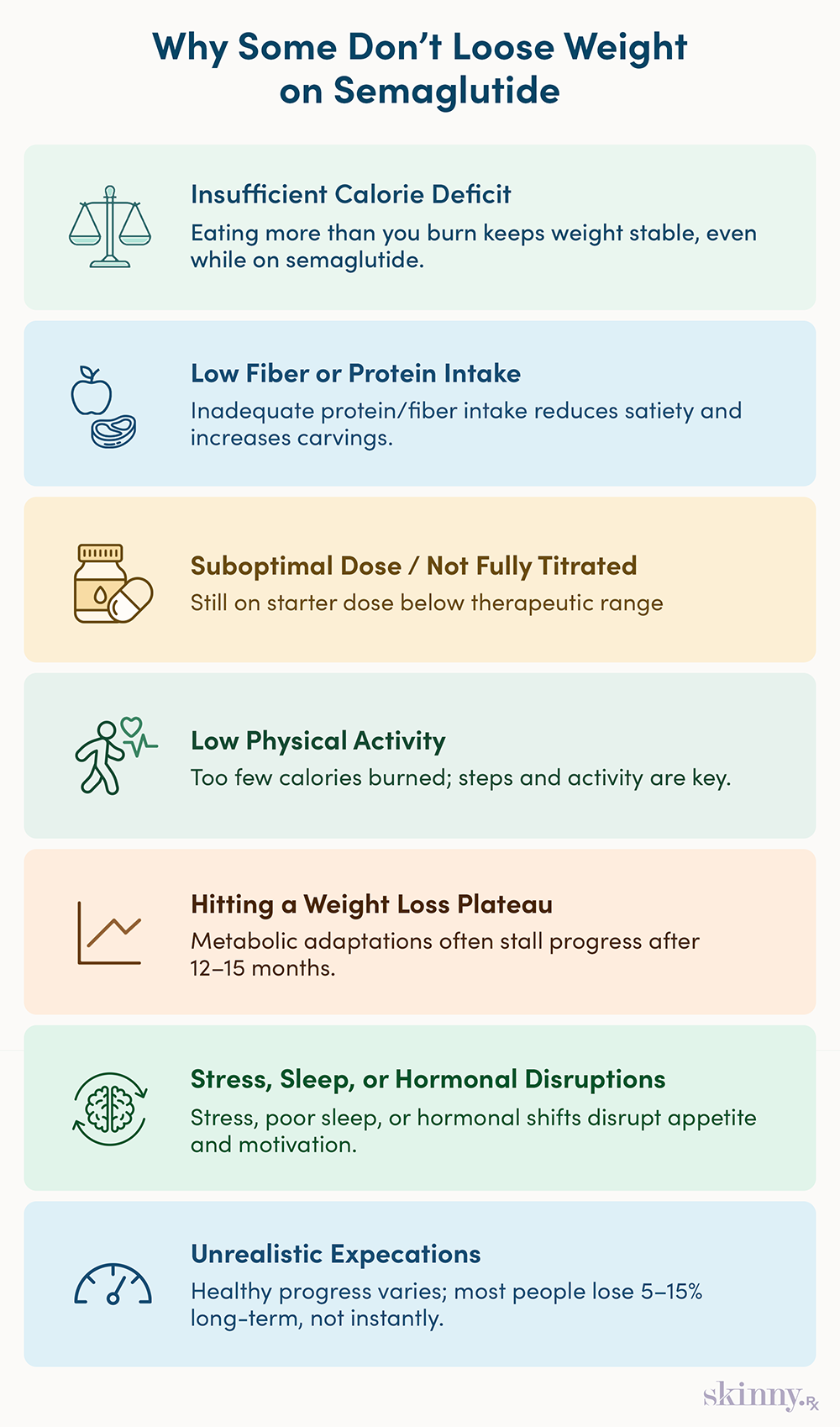
1. Insufficient Calorie Deficit
When it comes to weight loss, it helps to think like an accountant. Your body has an energy budget—it needs a certain amount of calories from food to maintain daily functionality, plus “pay for” any and all physical activity.
If you balance your energy budget, matching the amount of calories you consume to your average expenditure, your weight stays the same. But put your thumb on the scale in either direction, and things change.
This biological accounting equation holds true for just about everybody, including those taking semaglutide. GLP-1s don’t physically burn calories; they simply discourage you from eating too much, throwing your budget out of whack and causing you to store excess energy as fat.
So, if you’re not losing weight despite taking semaglutide, you probably aren’t in a calorie deficit. In fact, some studies have shown that intentional calorie restriction paired with semaglutide works better than either treatment done separately.
What To Do
You don’t strictly need to count calories to create a deficit. You could simply cut back on your portions at each meal, but dieting on vibes is hardly a reliable strategy.
Your best bet is to, at least temporarily, closely track everything you eat—snacks and even condiments count—for a few weeks to get a rough estimate of how many calories you’re actually consuming. You can do things the old-fashioned way by measuring servings and tallying with pen and paper, or turn to a nutrition app that scans your plate and generates estimations for you.
2. Lack of Protein or Fiber
“Eat less, lose weight” is, in broad strokes, a sure-fire approach. But other factors influence how much, or how often, you eat. Protein and fiber are among the most commonly-advised nutrients to prioritize in a diet.
Why? Protein is used to build, repair, and maintain muscle mass, along with being very satiating. Fiber also provides extra satiety, in addition to helping with gut and digestive health.
Researchers have observed a synergistic effect at play. “A lifestyle that involves higher intakes of protein and fiber .. may help blunt the increases in hunger and cravings that occur with weight loss,” according to a 2025 review.
What To Do
It pays to recalibrate your plate and ensure you’re getting adequate protein and dietary fiber. Protein needs vary tremendously depending on age, body size, and physical activity levels. A good rule of thumb is to have one primary protein source at each meal.
Regarding dietary fiber intake, the Mayo Clinic recommends consuming 14 grams of fiber per 1,000 calories eaten each day.

Expert-Guided, Sustainable Weight Loss
Discover how proven medications such as semaglutide or tirzepatide, combined with expert support, can help you reach lasting weight loss results.
3. Inadequate Physical Activity
Semaglutide is potent, but you can’t expect it to do all the work for you. Remember, its effects center around appetite regulation—GLP-1s aren’t thermogenics, which is to say their primary function isn’t burning calories for energy on their own.
Stalled weight loss can easily be attributed to low amounts of calories burned through scant physical activity, whether you’re on semaglutide or not.
What To Do
You don’t need to be in a gym to burn calories. All physical activity counts, some forms are simply more vigorous than others. If you don’t lead an active lifestyle, start simple. Increasing your daily step count has been shown to be correlated with weight loss, along with conferring a wide array of health benefits.
When it comes to steps, more is more for energy expenditure. If you can work up to accumulating 8 to 10,000 per day, you should start seeing changes in your weight while on semaglutide.
4. Not Taking an Optimal Dose
Dosage is everything when it comes to any pharmaceutical intervention. This is especially true for semaglutide, which is prescribed with a specific titration schedule. Dose titration refers to the rate at which a patient gradually increases the amount of the medicine they’re taking, to mitigate potential side effects and give the body time to adjust.
The starting dose for semaglutide is 0.25mg, which you inject once weekly for four weeks. Afterward, you typically begin increasing the dose until reaching a “therapeutic” level, or the point at which the medication produces the maximal desired effect.
Research indicates higher doses of semaglutide produce more potent effects on satiety and other factors that contribute to weight loss.
What To Do
If you’re just starting semaglutide, it’s likely you’re still ramping up your dosage. Weight loss doesn’t occur immediately, so wait until you’ve spent several weeks at your target dose (something you should discuss with your healthcare provider) before making any changes.
However, if you’ve reached a weight loss plateau after several weeks at your current dose of semaglutide, it’s worth consulting with your doctor about kicking things up a notch.
5. Hitting a Weight Loss Plateau
If the scale has stopped moving while taking semaglutide, you may have run into your first weight loss plateau. Semaglutide discourages overeating and dampens appetite, creating a gulf between the energy you expend and the amount you’re consuming—that’s a calorie deficit.
But over time, research tells us that that gap narrows. The human body is shrewd and will strive for balance through a number of different metabolic adaptations. Many people will experience a weight loss plateau on semaglutide around the 12-to-15-month mark.
What To Do
There are steps you can take to kickstart stalled weight loss on semaglutide. The cherry on top is that making these changes will benefit your health in other areas as well. To break through a plateau, you need to widen your “energy gulf” again by enforcing a calorie deficit.
To do so, you can:
- Double-check that you’re counting calories accurately, or begin tracking if you aren’t
- Eating more protein or fiber to increase satiety
- Add extra physical activity, particularly strength training, to build metabolically active muscle mass
6. Unmanaged Stress, Sleep, or Hormone Imbalances
There are circumstantial factors to consider while on a semaglutide weight loss journey; poor sleep and high stress can disrupt mood and throw your hormones into disarray. Over time, these can influence your behavior in a way that stalls your weight loss efforts.
What To Do
Contextual or environmental disruptions tend to have a cascading effect. A stressful day at work might cause you to lose sleep. Then, another domino falls—lack of sleep makes you irritable the next day, so you might skip your workout. It’s easy to feel like things have gone off the rails.
To mitigate these issues and their effects on your weight loss journey, it pays to be proactive. Try to limit stress as much as possible through mindfulness practices or an exercise routine. Establish good sleep hygiene, and stick to a consistent wake-rest schedule.
7. Unrealistic Expectations
Not losing weight on semaglutide is a problem. But what do you do if you are losing weight, just not at the pace you’d hoped? It helps to get a realistic perspective on what GLP-1s actually do long-term.
What To Do
A 2025 SCOPE trial of overweight patients taking semaglutide for over a year looked at their long-term weight loss outcomes. The authors highlighted the diverse, but significant, ways the 4,000+ patients responded to the medication:
- 88% of participants lost 5% of body weight or more.
- 72% of participants lost at least 10% of their body weight.
- Roughly half of the participants lost 15% of their weight or more.
What does this mean? Your bodily changes on semaglutide are unlikely to mirror those of others. If you know someone also taking semaglutide who seems to be doing better, consider asking them about the lifestyle changes they’ve implemented.
When to Consult Your Healthcare Provider
Many of the factors that delay or prevent weight loss on semaglutide can be solved without having to visit your doctor. That said, if you’ve tried holistic solutions like adjusting your diet or being more physically active, and you’re still not losing weight, it might be worth talking to your healthcare provider.
They’ll be able to give you informed feedback about whether you should increase your dose or even try a different approach, such as tirzepatide, in lieu of your current protocol.
If you’re considering whether semaglutide or tirzepatide could better support your weight-loss progress, you can take the SkinnyRx assessment to see what your treatment options may look like. Your responses are reviewed by a licensed healthcare provider, who will determine a safe and personalized plan aligned with your goals.
Frequently Asked Questions

By Jake Dickson, NASM-CPT, USAW-L2
Contributing Author
Jake holds a B.S. in Exercise Science from UNC Wilmington and began his career as a personal trainer and weightlifting coach. In recent years, he’s moved behind the page as a writer and editor, contributing hundreds of articles and being featured as a subject matter expert. Today, Jake’s goal remains the same: to empower people to change their lives by bringing heady scientific topics down to ground level.