
 Medically Reviewed

Key Takeaways
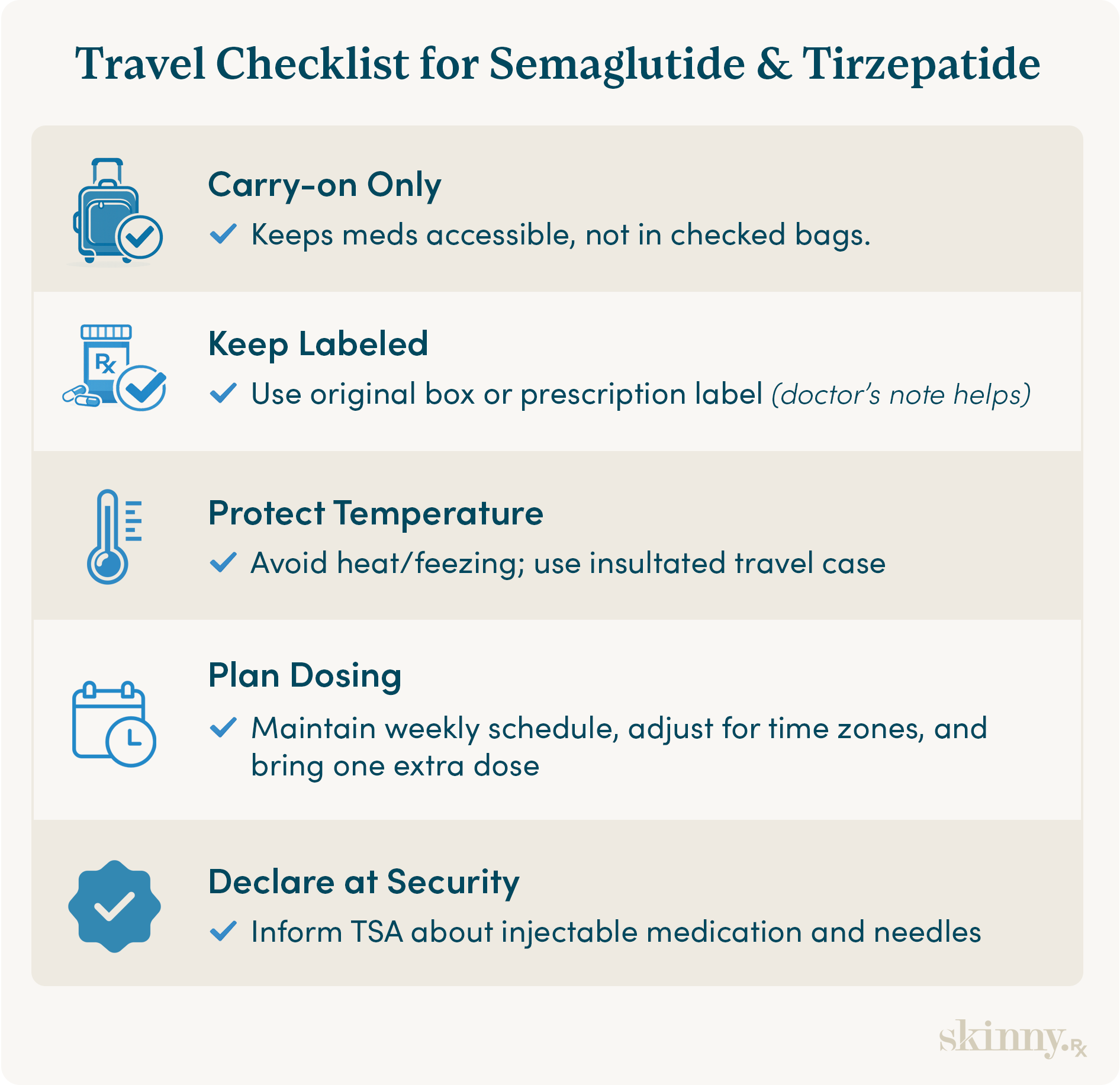
- Semaglutide and tirzepatide should always be kept in your carry-on or personal item, never in checked luggage, to avoid freezing temperatures and lost bags.
- These medications require careful temperature control, and an insulated travel case can help protect them from heat exposure during transit.
- Semaglutide and tirzepatide have strict storage rules, including specific limits on how long they can safely remain at room temperature.
- Injectable GLP-1 medications are exempt from TSA liquid restrictions, but should be kept labeled and declared separately during airport security screening.
- Injection timing can be adjusted for travel and time zone changes, as long as doses are not taken too close together.
Picture this: it’s the day before your trip. You’ve checked in for your flight, and you’ve packed your bags — except for one important item: your GLP-1 medication. If you’ve never traveled with refrigerated medication before, you’re probably wondering how traveling with semaglutide or tirzepatide works.
Read on as we share everything you need to know about flying with tirzepatide or semaglutide, TSA rules, and dosing schedules across time zones.
The Golden Rule: Never Put Medication in Checked Luggage
If you take away just one thing from this article, we hope it’s this: never put GLP-1 medications in your checked bags.
The Risk of Freezing and Lost Bags
The cargo hold of a plane can reach freezing temperatures, which can destroy the peptide structure of GLP-1 medications, rendering it unsafe or ineffective. Plus, checked bags are more likely to get lost, leaving you without your medication. (Officially, less than 1% of checked luggage gets mishandled, but you don’t want to be part of that 1%).
Keeping Meds in Your Carry-On or Personal Item
Instead, always pack your semaglutide or tirzepatide in your carry-on or personal item. This ensures your medication stays with you, and gives you more control over its temperature, which brings us to our next point.
Doctor-Guided Medical Weight Loss
Learn how prescription GLP-1 medications like semaglutide or tirzepatide may support weight loss when guided by a licensed medical provider and tailored to your health history.
Temperature Control: Do You Need a Cooler?
Whether or not you need a cooler when traveling with semaglutide or tirzepatide depends on which medication you’re taking and where you’re at in your dosing schedule.
Understanding the "Cold Chain" (Refrigeration vs. Room Temp)
Ideally, GLP-1s should be stored in their original carton in the refrigerator, at a temperature of 36°F–46°F (2°C–8°C).
When necessary, they can be stored at room temperature for a limited amount of time, but the amount of time differs depending on the medication. That’s why it’s a good idea to only bring the amount of doses you’ll need during your vacation (plus one extra in case your return flight gets delayed).
Once a pen or vial reaches room temperature, it cannot be put back in the fridge.
Ozempic/Wegovy Temperature Limits
- Ozempic: Unopened pens should be stored in the refrigerator prior to first use. Once opened, they can continue to be stored in the fridge or be moved to room temperature for up to 56 days (8 weeks).
- Wegovy: Ideally, pens should always be stored in the refrigerator. If necessary, however, unopened Wegovy pens can be stored at room temperature for up to 28 days (4 weeks) in their original carton.
Recommended Temperature Limits for Semaglutide
If your semaglutide medication comes in a vial, follow your prescriber’s instructions for temperature control. Do not freeze semaglutide.
Mounjaro/Zepbound Temperature Limits
- Mounjaro: Unopened pens and vials should be stored in the refrigerator. If necessary, they can be stored at room temperature up to 86°F (30°C) for up to 21 days (3 weeks).
- Zepbound: Unopened pens and vials should be stored in the refrigerator. If necessary, they can be stored at room temperature below 86°F (30°C) for up to 21 days (3 weeks).
Recommended Temperature Limits for Tirzepatide
Do not freeze tirzepatide.
Selecting the Right Travel Case (FRIO wallets, insulin coolers)
To avoid your medication from getting too warm during your flight, it can be helpful to use a FRIO wallet or a similar travel cooler for insulin pens. You never know when you might get stuck on the tarmac during a hot summer day (fingers crossed this doesn’t happen to you!).
Once you land and arrive at your destination, you can remove your pens or vials from the cooler and store them at room temperature. It’s important to note that these coolers do not get cold enough to be a good substitute for refrigeration, and once your GLP-1 reaches room temperature, it can’t be put back in the fridge.
If you use freezer packs, know that they must be fully frozen solid to pass through TSA and be allowed in your carry-on luggage. Be careful not to place your medication directly against the frozen part. GLP-1s should never be frozen.
Navigating Airport Security (TSA) with Injectables
Follow these travel tips for GLP-1 medications to get your tirzepatide or semaglutide through TSA.
TSA 3-1-1 Liquid Rule Exemptions for Medicine
Injectable medications like semaglutide and tirzepatide are exempt from the 3-1-1 Liquids Rule, so you don’t need to pack them in your Ziploc along with all your toiletries. In fact, you shouldn’t. TSA prefers that these medications be placed in a separate bowl when they go through screening.
How to Declare Your Medication to Officers
Before you go through screening, tell the TSA officer that you have medically necessary liquids, as well as needles or sharps containers (if you’re bringing those, too). They may test these separately before clearing them.
Pro Tip: Ask your healthcare provider to send you a copy of your prescription so you can take it with you when you travel. While not required by TSA, having your prescription with you can make the screening process smoother — especially when traveling internationally. It provides a clear explanation of what your medication is for, and shows that it is medically necessary and prescribed to you.

I often have patients request that I send them a copy of their prescription so they can take it with them when they travel. Even though that's not a TSA requirement, it's not a bad idea to pack a copy along with your medications and needles to help provide a clear explanation of what their medication and equipment are and that it is medically necessary and prescribed to you. This could be more important if traveling on international flights.
–
Dr. Daniel McGee, Board-certified Family Medicine Physician
The Necessity of Prescription Labels (Box vs. Pen)
If possible, pack your semaglutide or tirzepatide in its original carton with your prescription label clearly visible. If you don’t have your prescription handy, TSA recommends that the medication be clearly labeled to facilitate faster screening.
Note: TSA rules apply to the US, so if you’re traveling internationally, check the liquid medication requirements for that country. Most international security agencies (like CAA in the UK or CATSA in Canada) have similar rules, but carrying a copy of the prescription is often required when crossing international borders.
X-Ray Machines: Are They Safe for GLP-1s?
Yes, the TSA x-ray machines do not negatively affect medicine, including GLP-1s. It is safe for tirzepatide or semaglutide to go through the X-ray machine at TSA, but you can always request an alternative screening method.
Managing Your Schedule Across Time Zones
Are you taking GLP-1s abroad? Sticking to your regular dosing schedule can be a bit tricky when you’re traveling, especially when you’re flying across several time zones. Here are some of the common issues — and solutions — people run into while traveling with semaglutide or tirzepatide.
Shifting Your Injection Day (The 2-Day/3-Day Rule)
If you’re traveling internationally, it’s possible you’ll need to shift your injection day to account for the time zone change. Here’s how to change your injection day for tirzepatide or semaglutide:
- You can change your injection day for semaglutide as long as it’s been at least 2 days (48 hours) since your last dose.
- You can change your injection day for tirzepatide as long as it’s been at least 3 days (72 hours) since your last dose.
If you’re worried about missing a dose and having trouble calculating days with the time change, ask your provider ahead of your trip what they recommend. They may suggest taking your dose as soon as you remember, and then making that the new injection day for your medication moving forward.
What to Do If You Miss a Dose While Traveling
Let’s say you miss a dose while traveling. Here’s what to to do next, depending on the medication you’re taking:
- If you miss a dose of tirzepatide and it’s been less than 4 days (96 hours) since your missed dose, take the missed dose as soon as possible. Otherwise, skip the missed dose and take your next dose as usual on the regularly scheduled day.
- If you miss a dose of semaglutide and it’s been less than 5 days (120 hours) since your missed dose, take your missed dose as soon as possible. Otherwise, skip the missed dose and take your next dose as usual on the regularly scheduled day.
Pro Tip: If you’re traveling across time zones, don’t forget to factor in the time change when calculating how long it’s been between your doses.
Managing Side Effects Away from Home
For some people, travel and motion sickness go hand-in-hand. Throw in GLP-1s, and you may be in for a wild gastrointestinal ride. Thankfully, it’s absolutely possible to manage GLP-1 side effects while traveling.
Hydration Strategies for Flights
Staying hydrated can help you avoid common GLP-1 side effects like diarrhea, nausea, and constipation while traveling. But, avoid drinking too much all at once right before take-off. Having a large volume of liquid in your stomach can lead to motion sickness. Instead, sip slowly throughout your flight to stay hydrated.
Navigating "Vacation Eating" to Avoid Nausea
We all tend to go a bit ham when we’re on vacation, but it’s worth avoiding certain foods that can worsen nausea on GLP-1s, such as anything too fatty or fried. Here are some more tips for avoiding nausea on your trip:
- Avoid strong smells.
- Take small sips of clear drinks like water.
- Stop eating once you feel full.
- Avoid lying down after you eat.
- Go for a short stroll and get some fresh air after you eat.
- Drink 30–60 minutes either before or after a meal, but not during.
- As long as it’s been 30 minutes since your last dose, eat foods that can relieve nausea, such as apples, mint, crackers, or ginger.
- Eat bland or water-rich foods, like soup or crackers.
If your nausea doesn’t go away or becomes severe, contact a healthcare provider.
Frequently Asked Questions
Doctor-Guided Medical Weight Loss
Learn how prescription GLP-1 medications like semaglutide or tirzepatide may support weight loss when guided by a licensed medical provider and tailored to your health history.

By Amelia Willson
Contributing Author
Amelia Willson is a freelance health writer and content strategist based in Orange County, California. Her work has appeared in several health publications, including Ro, Klarity Health, K Health, Sleep Foundation, and A Place For Mom. Amelia covers the latest trends in health and wellness, including the research (or lack thereof) behind them, breaking down complex topics so that readers don't have to. Her writing frequently explores weight management, plant-based nutrition, and mental health.