

 Medically Reviewed

Key Takeaways
- GLP-1 medications and levothyroxine can often be used together, but they should be managed with guidance from a healthcare provider.
- Oral semaglutide may increase how much levothyroxine reaches the bloodstream over time, which is why thyroid hormone levels may need closer monitoring.
- Weight loss during GLP-1 treatment can change levothyroxine dose needs, even when the medications themselves are otherwise tolerated together.
- TSH, T3, T4, and thyroid antibody tests may be used to monitor thyroid function and guide treatment adjustments.
- Hypothyroidism is not the same as the medullary thyroid carcinoma risk addressed in GLP-1 warnings, but personal and family history should still be reviewed before treatment.
GLP-1 medications are most commonly prescribed for obesity and type 2 diabetes. These two conditions often overlap with certain thyroid problems. Diabetes often co-occurs with hypothyroidism, which is when the thyroid doesn’t produce enough of essential hormones. Additionally, weight gain can be a symptom of hypothyroidism too.
The connection brings up questions about how to safely take a GLP-1 alongside thyroid medications, such as levothyroxine. And as with any medication duo, it’s important to understand how GLP-1s and thyroid medications interact before taking the two together.
Semaglutide and levothyroxine are not contraindicated, meaning they can be taken at the same time. However, there are timing, absorption, and dose concerns when it comes to combining a GLP-1 and this thyroid medication, which is why clinical guidance and careful monitoring are important for people taking both.
How GLP-1s Affect Thyroid Medication Dosing
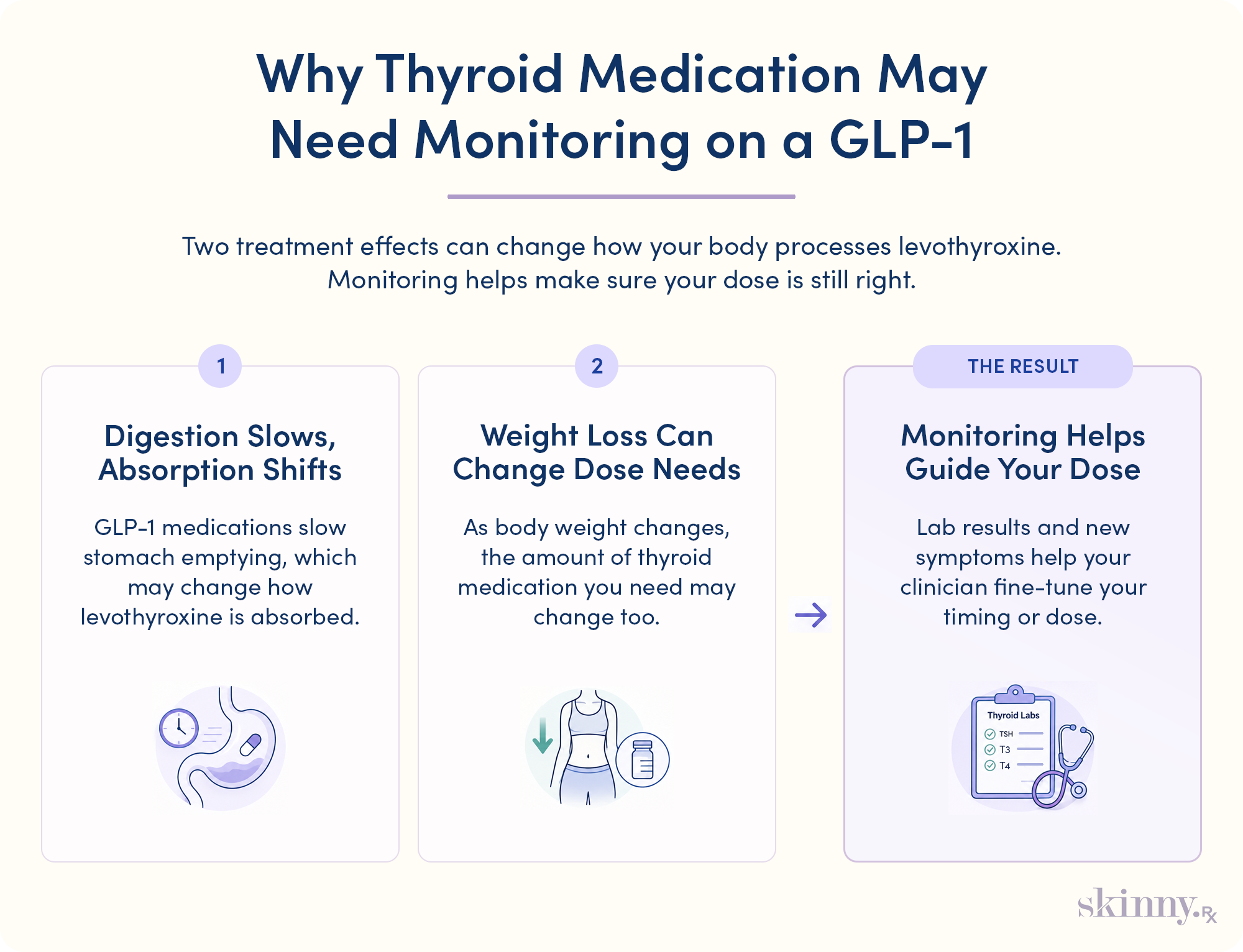
A key feature of GLP-1 medications is that they slow gastric emptying. This is why someone may feel full for longer after eating after they start a GLP-1. It also contributes to the medication’s role in aiding blood sugar regulation.
But when stomach contents move more slowly into the small intestine, there can be other consequences, including any other oral medications that someone takes staying in the stomach for longer than intended. For those with a thyroid condition, one of those other prescriptions may be levothyroxine.
In a 2021 study, patients who took both oral semaglutide and levothyroxine experienced a 33% increase in total T4 exposure, which can indicate higher-than-intended exposure. This raises the possibility of over-replacement of this thyroid hormone, rather than underreplacement.
The researchers recommended that healthcare providers monitor thyroid levels for patients on both medications and adjust the doses as needed. They did not indicate that the two medications are contraindicated or unable to be taken together.
Another reason GLP-1s may impact levothyroxine is the drug’s weight loss effect. A 2026 paper in the Journal of Clinical Endocrinology and Metabolism studied thyroid levels in patients over 65 who took both medications. The researchers noted that as patients lost weight, their thyroid levels changed and they often required levothyroxine dose modifications.
Importantly, they also found that for many patients, TSH testing did not increase after starting a GLP-1. This suggests a need for closer monitoring of thyroid hormone levels for people on this medication.
Like the 2021 study, the authors of this 2026 paper didn’t recommend against taking the medications together. Instead, they stated a healthcare provider should carefully monitor thyroid hormone levels for patients who take both.
In fact, other studies suggest that GLP-1s offer significant benefits for patients with hypothyroidism and type 2 diabetes. In a 2026 comparative study, participants who took both a GLP-1 and levothyroxine experienced additional metabolic and cardiovascular effects compared to those who took only one of the two medications.
What the Oral Semaglutide Label Says About Levothyroxine
The oral semaglutide drug label from the FDA mentions a possible difference in levothyroxine absorption for people who take both medications. It cites the data from the 2021 study above, and further recommends that a healthcare provider should carefully monitor thyroid hormone levels for patients who take both medications.
However, the label does not recommend stopping either. If concerned about how these medications may interact, bring up any questions with the prescribing healthcare provider or pharmacist.
While some people on both medications may need to adjust their doses, many people safely take the two medications together.
Does This Apply to Every GLP-1?
While the FDA label for oral semaglutide is the only one that mentions levothyroxine, a provider may want to monitor thyroid hormone levels for people with hypothyroidism who take any type of GLP-1.
As a 2024 meta-review points out, there currently isn’t clear guidance on GLP-1s and thyroid medications, and more research is necessary to confirm how these medications interact. That means a healthcare provider may wish to monitor thyroid hormone levels for patients who take a GLP-1 type alongside levothyroxine, regardless of if that GLP-1 is in an oral or injectable form.
GLP-1s and Thyroid Risk
In studies with rodents, GLP-1 medications are associated with the development of thyroid C-cell tumors (also known as medullary thyroid carcinoma). Findings in animal studies don't always translate to humans, but these drugs are contraindicated (not recommended) for those with a family history of medullary thyroid carcinoma (MTC).
MTC is not the same thing as hypothyroidism, and hypothyroidism is not associated with a higher risk of MTC.
Still, a family history of MTC may be present in some people with hypothyroidism, independent of the condition. A healthcare provider will assess someone’s risk of MTC before prescribing a GLP-1.
See If GLP-1 Care Is Right for You
Complete an assessment, and a licensed clinician will review your health information. If GLP-1 treatment is appropriate, they can prescribe a medication and provide ongoing clinical guidance throughout your care.
Thyroid Labs Your Clinician May Monitor
The thyroid is a small organ in the throat that creates essential hormones. These hormones affect everything from breathing to mood to heart rate, which makes thyroid problems hard to detect because symptoms are so widespread.
Fortunately, there are specific labs that help healthcare providers monitor thyroid hormone levels.
These labs are typically used to diagnose conditions like hypothyroidism, when the thyroid doesn’t produce enough hormones, or hyperthyroidism, when the thyroid produces too many hormones. They can also be taken throughout treatment to monitor any changes.
If taking a GLP-1 alongside a thyroid medication, a clinician may routinely order one or more of the following thyroid labs:
- TSH test: Measures thyroid-stimulating hormone (TSH) in the blood, though it can’t show why TSH levels are too high or too low.
- T3 test: Assesses triiodothyronine (T3) in the blood and is often used to monitor hypothyroidism treatment.
- T4 test: Determines thyroxine (T4) levels in the blood and can help monitor treatment effectiveness for thyroid conditions.
- Thyroid antibody tests: Measure specific antibodies in the blood and are often used when someone has a thyroid autoimmune disease, such as Hashimoto’s disease.
Questions to Ask Your Pharmacist or Prescriber
Taking a thyroid medication alongside a weight loss medication requires careful monitoring from the prescribing healthcare provider and pharmacist.
To better understand how your provider approaches the two medications, ask:
- Which GLP-1 formulation am I using: injectable or oral? How will it interact with levothyroxine?
- When do I take levothyroxine and my GLP-1?
- When do I take any other oral medications or supplements?
- Should my TSH or thyroid labs be checked after starting or changing treatment?
- What symptoms of too much or too little thyroid hormone should I report?
- Should a pharmacist review my full medication list before I start taking a GLP-1?
When to Report Symptoms
Report any symptoms that are either new or went away but then came back after taking a GLP-1 medication to a healthcare provider.
Symptoms of too little thyroid hormones (hypothyroidism) include:
- Weight gain
- Trouble tolerating cold
- Constipation
- Fatigue or excessive tiredness
- Joint pain
- Muscle aches or pain
- Dry skin
- Thinning hair
- Slowed heart rate
- Heavy menstrual cycles
- Irregular menstrual cycles
- Feeling depressed more often than usual
Symptoms of too much thyroid hormone (hyperthyroidism) are:
- Weight loss combined with eating more than usual
- Irregular, fast heartbeat
- Shaky hands
- Muscle weakness
- Trouble sleeping
- Fatigue
- Irritability
- Feeling anxious more often than usual
- Trouble adjusting to warm weather
- Too many bowel movements
- A goiter, which is an enlargement of the neck
Weight loss is a main impact of GLP-1 medications, which may make it difficult to tell when a decrease on the scale stems from the weight loss medication or disruptions to the thyroid hormones in the body.
A key difference is that weight gain from hyperthyroidism occurs alongside an increase in appetite, while GLP-1 medications suppress appetite. If a patient is losing weight while eating more, that points toward hypothyroidism, not the GLP-1 itself.
Similarly, changes in bowel movements may be a side effect of GLP-1s. If experiencing bowel movement changes, such as constipation or diarrhea, that are severe and/or interfere with everyday life, report them to a healthcare provider. They can then determine the cause and make any necessary treatment adjustments.
Bottom Line
GLP-1 medications and levothyroxine can often be taken together under the guidance of a healthcare provider. However, GLP-1s may affect levothyroxine absorption, while weight loss itself can change how much thyroid medication you need.
Because of this, your healthcare provider may monitor your thyroid hormone levels more closely after you start a GLP-1 or change your dose. Ask about medication timing, lab testing, possible dose adjustments, and symptoms that could signal too much or too little thyroid hormone.
You should also mention any personal or family history of medullary thyroid carcinoma before beginning treatment.
Frequently Asked Questions
See If GLP-1 Care Is Right for You
Complete an assessment, and a licensed clinician will review your health information. If GLP-1 treatment is appropriate, they can prescribe a medication and provide ongoing clinical guidance throughout your care.

By Angela Myers
Contributing Author
Angela Myers is a freelance health writer covering weight management, healthy aging, and nutrition. Her work has appeared in AARP, Well+Good, and Forbes, among others. Before starting her writing career, she conducted award-winning research on how to improve sexual violence prevention courses on college campuses. That research sparked a passion for health communication, and she's been writing about making healthcare accessible and inclusive ever since.