

 Medically Reviewed

Key Takeaways
- GLP-1s may support heart health in ways that go beyond weight loss, including effects on inflammation, blood vessels, and HFpEF symptoms.
- Semaglutide has been shown to reduce major cardiovascular events in certain adults with overweight, obesity, type 2 diabetes, or established heart disease.
- Early research suggests GLP-1s may help stabilize arterial plaque and support healthier blood vessel function, but these findings are still developing.
- Semaglutide and tirzepatide may be especially relevant for some people with obesity-related HFpEF, a form of heart failure linked to stiffness in the heart muscle.
- These benefits are not universal; the strongest evidence applies to specific higher-risk groups, not the general population.
Protecting heart health is an important goal. After all, about one in ten Americans have heart disease, and it’s a leading cause of death.
Fortunately, there are steps you can take to protect cardiovascular health, such as following a heart-healthy diet, getting regular exercise, and reducing stress. For some individuals, a heart-healthy lifestyle may also include a GLP-1 medication.
Recent clinical trials suggest semaglutide and other medications that mimic GLP-1 may reduce the risk of cardiovascular events like heart attacks and stroke, help treat heart failure, and offer other cardiovascular benefits.
Continue reading to learn more about GLP-1’s emerging role in cardiovascular health.

In my practice, GLP-1s are one of the tools I use for improving metabolic health. The cardiovascular data has been encouraging, and in the right patients, they’re usually well tolerated and can really help make a difference when combined with lifestyle changes.
–
Dr. Daniel McGee, Board-certified Family Medicine Physician
GLP-1s And Preventative Cardiology
GLP-1 receptor agonists are a class of drugs that mimic the effects of the naturally occurring hormone GLP-1. This hormone is best known for its role in blood sugar regulation and weight management, though it may also help protect heart health.
"In my practice, GLP-1s are one of the tools I use for improving metabolic health,” says Daniel McGee, D.O., a board-certified family medicine physician, “The cardiovascular data has been encouraging, and in the right patients they’re usually well tolerated and can really help make a difference when combined with lifestyle changes."
There are a few reasons why GLP-1 medications influence the cardiovascular system:
- Weight loss: Obesity and being overweight are risk factors for heart disease. Since GLP-1 medications may promote weight loss, they might reduce the weight-related risk for heart conditions.
- Reduce the risk of cardiovascular events: Ozempic and Wegovy are two medications with a cardiovascular risk-reduction indication, meaning they are recognized to help lower the risk of serious cardiovascular events in adults with established heart disease who also have type 2 diabetes or obesity. These events include heart attacks, strokes, and cardiovascular deaths.
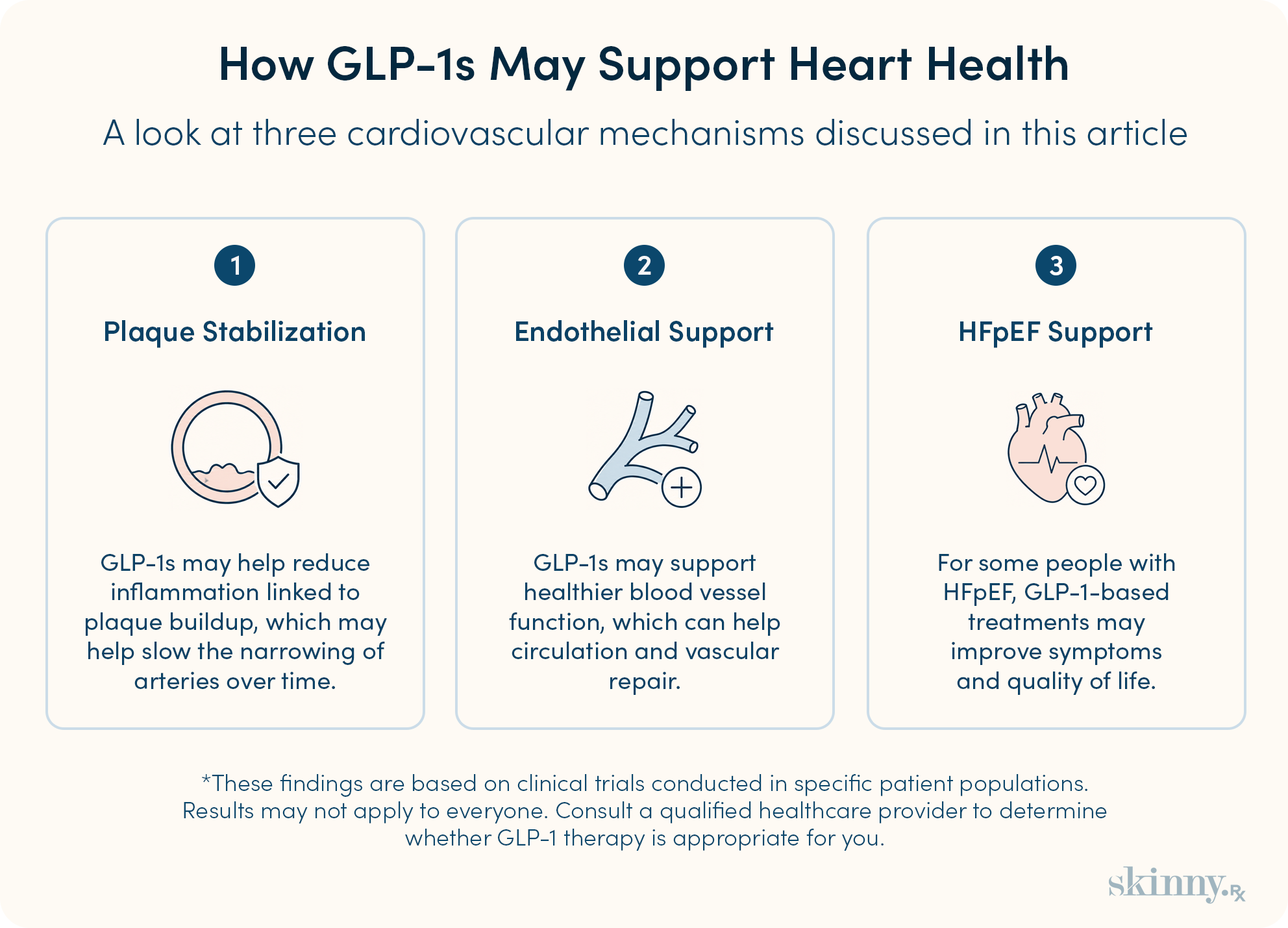
- Improve certain aspects of heart health: Beyond the number on the scale, GLP-1 medications may also provide heart-specific benefits, such as plaque stabilization, support for endothelial repair, and help manage a specific type of heart failure. We’ll dive into these three benefits in the next section. For now, note that GLP-1s could provide a “triple-threat” against heart conditions.
FDA-Approved Medications for Heart Health
While there are multiple types of GLP-1 drugs that are approved to reduce the risk of adverse cardiovascular events, they’re all approved for slightly different patient populations.
Three Ways GLP-1s Protect the Heart Beyond Weight Loss
Research into why GLP-1s support heart health is still underway, though recent studies suggest these medications may act through three distinct mechanisms to reduce heart disease and conditions such as heart failure. All three go beyond weight loss from GLP-1s, though losing weight may have a significant impact on cardiovascular health, too.
1. Plaque Stabilization: Preventing the Rupture
When too much plaque builds up in the artery walls, they narrow. This restricts blood flow to and from the heart, which is a primary driver of heart disease. Plaque can build up for many reasons, and it seems to be associated with more systemic inflammation.
Reducing inflammation may reduce plaque in the arteries, and that’s where GLP-1s come in. In some clinical trials, inflammation levels decreased by an average of 43% for participants who took a GLP-1 medication.
Animal studies take this a step further, directly linking GLP-1s to lower plaque levels in the heart. A few human studies support this effect, too, though more research on plaque reduction is required to confirm this benefit.
2. Endothelial Repair: How GLP-1s Help Blood Vessels Self-Heal
Endothelial repair refers to the process by which blood vessels self-heal from any damage. This process is essential for blood circulation and cardiovascular health. If the process doesn’t work as intended and blood vessels don’t self-repair, it’s referred to as endothelial dysfunction. In clinical studies, GLP-1 medications offer a protective element that supports endothelial function.
Explore Personalized Weight Loss Options
Start with an online assessment to help a licensed clinician determine whether a prescription weight loss treatment, along with guided nutritional support, may be appropriate for you.
3. Treating HFpEF: Early Evidence and Promise
The heart’s main purpose is to keep blood flowing throughout the body. When the heart cannot pump enough blood, it’s known as heart failure. There are two main types of heart failure, and over 50% of patients have heart failure with preserved ejection fraction (HFpEF), which is sometimes referred to as a “stiff heart.”
With HFpEF, the heart still circulates blood normally, but the heart muscle is too stiff to relax and allow heart chambers to fill with blood between each beat. GLP-1 medications offer a possible treatment option for HFpEF. In clinical trials, semaglutide and liraglutide reduced HFpEF symptoms and improved participants' overall quality of life.
The SELECT and SUMMIT Trials
Most of the data supporting GLP-1's impact on heart health comes from two large-scale clinical trials: SELECT and SUMMIT.
The SELECT Trial
- Participant profile: 17,604 participants who were all over 45, had a body-mass index (BMI) of 27 or above, did not have diabetes, and had established cardiovascular disease, such as a prior heart attack or stroke. 8,803 received semaglutide; 8,801 received a placebo. It is worth noting that roughly two-thirds of participants had prediabetes at baseline, though none had a formal diabetes diagnosis.
- What was studied: The incidence of major adverse cardiovascular events
- Outcome: Semaglutide reduced the relative risk of adverse cardiovascular events by 20%, translating to an absolute reduction of 1.5 percentage points, from 8.0% in placebo participants to 6.5% in semaglutide participants.
- Important context: The cardiovascular benefit appeared to be independent of how much weight participants lost, suggesting GLP-1s may act on the heart through pathways beyond weight reduction alone.
- Why this matters: For a high-risk population, these findings are clinically meaningful. Researchers estimated that roughly 67 patients would need to be treated to prevent one major cardiovascular event. While that number may sound modest, cardiovascular researchers consider it a strong result for this type of high-risk prevention trial.
The SUMMIT Trial
- Participant profile: 731 participants who had a BMI of 30 or above, as well as heart failure with an ejection fraction of at least 50%. 364 took tirzepatide, a medication that mimics both GLP-1 and a second hormone called GIP, and 367 received a placebo. This trial was considerably smaller than the SELECT trial, which is worth keeping in mind when weighing its findings.
- What was studied: Cardiovascular death and worsening of heart failure over a median follow-up of roughly two years
- Outcome: Tirzepatide reduced the combined risk of cardiovascular death and worsening heart failure events by approximately 38%, driven largely by a 46% reduction in worsening heart failure events requiring hospitalization or urgent care.
- Important context: While worsening heart failure events were meaningfully reduced, cardiovascular deaths were numerically higher in the tirzepatide group at 2.2% versus 1.4% in the placebo group. Researchers noted this difference was not statistically significant and may be due to chance, but it is a finding worth disclosing honestly.
- Why this matters: The findings suggest that GLP-1-based medications may play a meaningful role in managing heart failure in people with obesity, though the smaller trial size means further research is needed to confirm these results.
Is the Benefit Only From Weight Loss?
GLP-1s also have an impact on cardiovascular plaque, endothelial repair, and heart failure treatment, independent of their impact on weight.
However, it’s worth pointing out that these findings are based on patient populations who either had obesity, were overweight and had one or more weight-related conditions, and/or had type 2 diabetes. These findings may not be applicable to more general patient populations.
Plus, being overweight, having obesity, and/or having type 2 diabetes are all significant risk factors for heart disease. GLP-1s may offer multiple cardiovascular benefits, both through their effects on the cardiovascular system and on metabolic health.
The Future: 2026 Medicare Guidelines and Access
Many insurance plans cover GLP-1 medications, significantly bringing down out-of-pocket costs. Up until recently, that list of insurance providers didn’t often include Medicare.
Historically, Medicare Part D, the program's optional drug insurance benefit, offered extremely limited coverage for Ozempic. It used to cover it only when prescribed for type 2 diabetes or cardiovascular disease, not for weight management or any other purposes
Due to clinical data supporting GLP-1 medications for weight management and heart health, the Centers for Medicare & Medicaid Services created the “Medicare GLP-1 Bridge” program. This initiative aims to gradually expand access to GLP-1 medications and will roll out gradually, starting in July, 2026.
When prescribed for weight management, the following drugs will soon be eligible for Part D coverage:
- Foundayo
- Wegovy (injection and oral tablet)
- Zepbound (mimics GLP-1s and another hormone, GIP)
Medicare will also cover Wegovy for the risk reduction of major adverse cardiovascular events for those with established heart disease and/or who have obesity or are overweight. Medicare will continue to cover Ozempic when prescribed for cardiovascular disease or type 2 diabetes.
Why Your Cardiologist May Be Prescribing GLP-1s
If a cardiologist recommends GLP-1s, it could be for a few reasons:
- To improve the cardiovascular health of those with insulin resistance or excess weight
- To reduce the risk of disease progression for those with established heart disease.
- To be part of a treatment plan for heart failure
A primary care doctor or other qualified healthcare provider may also prescribe GLP-1s. If curious about why a healthcare professional is prescribing a GLP-1 medication, ask them.
A prescribing healthcare provider can also recommend lifestyle and dietary changes that complement GLP-1s, potentially providing an even more significant impact on heart health.
The Bottom Line
The evidence surrounding GLP-1s and cardiovascular health is still developing, but the early data is encouraging. For certain individuals, these medications may offer meaningful heart health benefits that go well beyond weight loss.
From reducing inflammation to supporting blood vessel function and helping manage specific types of heart failure, the research suggests GLP-1s may work on the cardiovascular system through several distinct pathways.
As with any prescription medication, whether a GLP-1 is appropriate depends on your individual health history and goals. A qualified healthcare provider can help determine if it is the right fit for you.
Frequently Asked Questions
Explore Personalized Weight Loss Options
Start with an online assessment to help a licensed clinician determine whether a prescription weight loss treatment, along with guided nutritional support, may be appropriate for you.

By Angela Myers
Contributing Author
Angela Myers is a freelance health writer covering weight management, healthy aging, and nutrition. Her work has appeared in AARP, Well+Good, and Forbes, among others. Before starting her writing career, she conducted award-winning research on how to improve sexual violence prevention courses on college campuses. That research sparked a passion for health communication, and she's been writing about making healthcare accessible and inclusive ever since.