

 Medically Reviewed

Key Takeaways
- Delayed gastric emptying from GLP-1s can leave your stomach fuller than standard fasting windows account for, which raises your aspiration risk during sedation.
- Most patients can remain on their GLP-1 through elective surgery because newer guidance leans toward individual risk assessment rather than blanket hold periods.
- When a pause is warranted, daily formulations usually stop the day of the procedure, while weekly injectables stop about a week out.
- Nausea, reflux, or vomiting are not automatic dealbreakers, but they do raise your aspiration risk and shape your care team's decision.
- Your dosing schedule, active symptoms, and personal risk profile determine the final plan, so you must share all three details with your care team.
One in eight Americans is using, or has used, a GLP-1. About one in nine people undergo surgery each year. When the numbers align this closely, it pays to be cautious.
Should you take your GLP-1 before surgery, a colonoscopy, or procedures that require sedation? At first, you might think the two have nothing to do with each other. But the American Society of Anesthesiologists (ASA) urges caution: "The potential benefit of withholding GLP-1s around surgery must be balanced against the risks."
Why? GLP-1s delay gastric emptying, which drastically impacts pre- and peri-surgery protocols. Here's what you need to know about GLP-1s before surgery.
How GLP-1s Affect Your Upcoming Procedure
GLP-1s directly affect your procedure because they delay gastric emptying and put an "ileal brake" on your digestive system. This brake slows the rate at which your body processes and passes food, meaning food remains in your stomach much longer than it otherwise would.
It's not a new phenomenon—scientists have discussed using this mechanism to control appetite for decades. Because food stays in the stomach longer, patients feel fuller longer, which reduces the compulsion to overeat. But while these effects work incredibly well for managing weight, having that partially digested food still sitting in your system is exactly what creates complications when it's time for anesthesia.
The Aspiration Risk: A Critical Safety Concern
Aspiration describes the movement of food, liquid, or other stomach contents into the lungs. Physical reflexes like coughing, gagging, or swallowing help you avoid aspiration, but are completely suppressed when you're anesthetized.
GLP-1 users carry a much higher risk of having retained stomach contents get into the lungs during sedation due to the drug's ability to slow gastric emptying. This is a life-threatening medical emergency. Pulmonary aspiration can cause severe chemical lung damage (aspiration pneumonitis), acute respiratory failure, and serious long-term complications.
Crucially, standard pre-surgery fasting windows (such as stopping solid foods 6 to 8 hours before a procedure) are often insufficient for GLP-1 users. Because the stomach empties so slowly, a patient can strictly follow normal fasting rules and still arrive at the operating room with a full stomach.
While this increased risk doesn't prohibit GLP-1 users from going under, it forces medical teams to treat these cases with "full stomach" precautions, modifying their anesthesia plans or altering pre-op prep to actively protect your lungs.
Current Guidance Best Practices
The American Society of Anesthesiologists believes most patients may continue taking their GLP-1s leading up to elective surgery unless their medical teams specifically advise otherwise.
There’s a clinical emphasis on collaborative, patient-tailored approaches: “GLP-1 use … should be based on shared decision-making of the patient with the care team…”
Healthcare staff need to be aware of factors like:
- Elevated symptom prevalence during the titration phase
- Dose magnitude and how side effect prevalence increases accordingly
- Daily oral vs. weekly injectable dosing
As well as associated conditions which may synergize with the issues GLP-1s present. This can include bowel dysmotility, gastroparesis, or Parkinson’s disease.
When to Pause: Daily vs. Weekly Formulations
Contemporary guidance for GLP-1 cessation before surgery is evolving. In 2023, the ASA took a conservative approach, advising patients on weekly-dosed GLP-1s to skip their last dose a week before surgery, and for daily-dosed GLP-1s to be held on the day of.
Updated multi-society guidance aligns with broader recommendations which prioritize individualized risk factors for aspiration and other complications, rather than dosing frequency alone. Your doctor can assess your personal risk profile and make an informed decision.
However, if your care team determines it is necessary to pause your medication to mitigate aspiration risks, the standard clinical protocol defaults back to how your specific GLP-1 is formulated:
- Daily Oral Formulations (e.g., daily oral semaglutide or daily liraglutide): Should generally be held on the day of the procedure.
- Weekly Injectable Formulations (e.g., weekly semaglutide or weekly tirzepatide): Should generally be held for one full week (7 days) before the procedure.
If your team decides it is safest for you to continue your GLP-1 up until surgery, they will often prescribe a 24-hour preoperative liquid diet or perform a point-of-care gastric ultrasound to physically confirm your stomach is empty before administering sedation.
Explore Your Weight Loss Options
Explore personalized weight loss treatment options with licensed healthcare providers. If treatment is appropriate, they'll help you choose a plan that fits your health goals and medical needs.
Who May Need Extra Planning
GLP-1s before surgery are generally safe in otherwise healthy or low-risk individuals. That said, you may need to exercise caution before surgery if you fall under specific criteria. These factors may require extra planning on your or your healthcare team’s part.
People Early in Treatment
GLP-1s are titrated. They start at a very conservative dose and over a period of months ramp to what's called a therapeutic dose, or the specific amount of medication that best addresses the target issue while minimizing side effects.
This ramp-up period helps people adjust to the drug but is also when side effects tend to be most prevalent—specifically the gastrointestinal issues that can complicate some surgeries.
If you have surgery scheduled and are still titrating your GLP-1, you should disclose that information to your doctor as early as possible; they may want to delay the surgery until your system stabilizes.
People With Nausea, Vomiting, or Acid Reflux
Gastrointestinal symptoms like nausea, vomiting, or acid reflux can interfere with surgery safety, whether you're on a GLP-1 or not.
Active nausea or reflux indicates that gastric emptying is actively delayed, which severely increases aspiration risks and heavily influences whether your care team will choose to pause the medication.
People Having Procedures With Sedation
GLP-1s aren't known to negatively interfere with medical sedatives—at least not directly. The delayed gastric emptying from GLP-1 can, however, affect the metabolism and efficacy of certain oral sedatives, as well as precipitate an increased risk of aspiration under twilight sedation.
Working around these issues falls mainly on the medical team, not the patient. Healthcare providers may opt to utilize gastrointestinal prokinetics such as metoclopramide to counteract the digestive slowdown and ensure a sedative or anesthetic is effectively distributed throughout the body.
What To Tell Your Medical Team
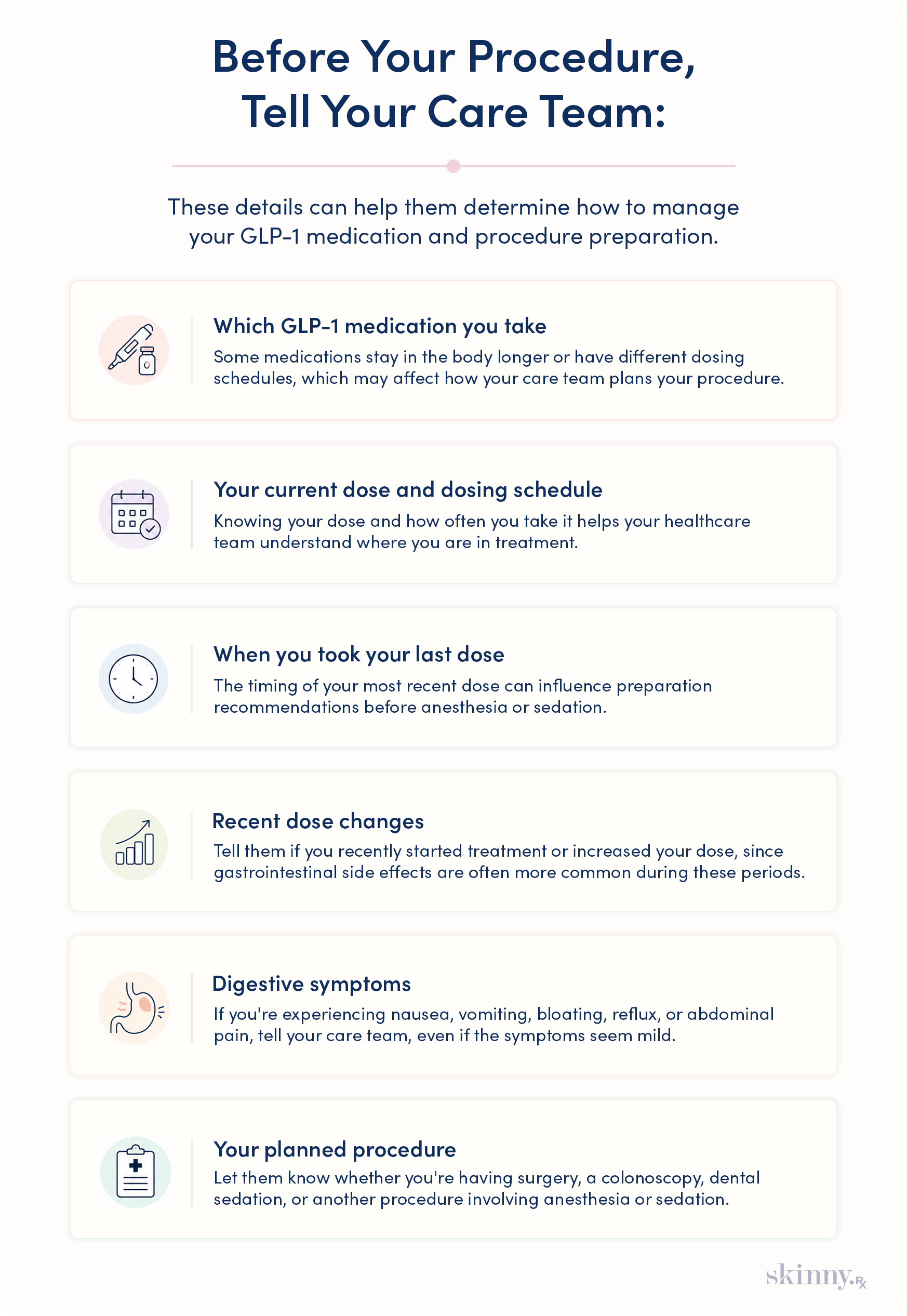
Your medical team needs comprehensive, accurate information about your health history in order for them to do their jobs effectively. That means disclosing everything. Most of this information will be prompted by medical staff in advance of any procedure. Be prepared to have specifics on:
- Medication details: Exact brand name, dose, protocol, and date/time of most recent dose.
- Medication changes: Recent adjustments to dose or delivery mechanism, as well as what stage of titration (if applicable).
- Current symptoms: Even minor or transient nausea, vomiting, stomach pains, cramping, indigestion, gas, bloating, or reflux.
You should also disclose any other medications you're taking, especially if your healthcare team decides to postpone GLP-1 use to perform surgery.
In short: Tell your healthcare team everything.
GLP-1s and Surgery: Questions To Ask
Beyond disclosing your healthcare information, you likely also have questions before surgery. Inpatient and outpatient procedures alike can be stressful. Getting informed reduces anxiety.
Keep these questions front-of-mind:
- Based on my specific risk profile, should I pause or continue my GLP-1?
- If we pause, exactly how many days before surgery should I hold my daily or weekly dose?
- Should I transition to a 24-hour liquid diet prior to the procedure to ensure my stomach is empty?
- How does my surgery prep interact with a GLP-1 dosing schedule?
Bottom Line
GLP-1s and surgery can safely coexist, but the timing must be handled with care. Because these medications slow down your digestion, standard fasting rules do not always guarantee an empty stomach.
To keep you safe, your care team will evaluate your personal risk profile to decide if you need to pause your medication. If a pause is necessary, the timing depends on your specific formulation. Daily oral doses are typically held on the day of the procedure, while weekly injectables are held a full week out. The right plan depends entirely on your schedule, your symptoms, and how your body responds to the treatment.
The best thing you can do is communicate. Tell your care team about every symptom, even the minor ones, and ask direct questions so you go into your procedure prepared and protected.
Frequently Asked Questions
Real Support for Lasting Results
Explore personalized weight loss treatment options with licensed healthcare providers. If treatment is appropriate, they'll help you choose a plan that fits your health goals and medical needs.

By Jake Dickson, NASM-CPT, USAW-L2
Contributing Author
Jake holds a B.S. in Exercise Science from UNC Wilmington and began his career as a personal trainer and weightlifting coach. In recent years, he’s moved behind the page as a writer and editor, contributing hundreds of articles and being featured as a subject matter expert. Today, Jake’s goal remains the same: to empower people to change their lives by bringing heady scientific topics down to ground level.