

 Medically Reviewed

Key Takeaways
- Microdosing tirzepatide has not been studied in clinical trials or validated, so its safety, effectiveness, and long-term impact remain unknown.
- Standard tirzepatide dosing is built on research showing that therapeutic benefits require reaching a studied dose threshold.
- The rise of microdosing is driven by social media anecdotes rather than evidence, leading users to overestimate its potential.
- Attempting partial doses with injection pens often leads to inaccurate administration because the devices are not designed for microdosing.
If you’re thinking about microdosing tirzepatide because you’ve seen it discussed on social media, there are a few things you need to know. While it may have some online hype as an emerging trend for casual, stress-free weight loss, tirzepatide microdosing comes with a host of risks.
We’re breaking down the origins and motivations of this growing trend and explaining why off-label usage of GLP-1s isn’t advisable.
What Is Tirzepatide Microdosing?
In order to understand the risks associated with the low-dose tirzepatide trend, we need to lay some groundwork. Put simply, microdosing refers to taking a smaller-than-prescribed dosage of a medication or supplement, typically with the aim of enjoying a mild version of the substance’s benefits without potential side effects, or to stretch out their supply as a cost-saving measure.
Simple enough—and if you’re just beginning your health and wellness journey, microdosing tirzepatide can certainly sound like a compelling weight loss hack to some, but that's not always the case. Let’s take a more objective view.
Standard Dosing
Tirzepatide is a dual-action GLP-1 and GIP agonist. It regulates blood sugar, curbs cravings, and helps you feel full, which has led to its explosion in popularity as an appetite suppressant and weight regulator.
The standard starting dosage of tirzepatide is 2.5mg, administered as a once-weekly subcutaneous injection, which you can perform on yourself.
The Allure of “Less Is More”
At a glance, “skipping” the side effects of tirzepatide or “stretching your dollar” by microdosing seems like a good idea. After all, as the old saying goes, the dose makes the poison. It’s easy to think that by taking less, you can get at least some of the benefits without reaching a threshold that includes any drawbacks.
This perspective aligns with how we tend to approach our health. A clean, minimalist approach is conservative and efficient—and can be especially charming while we’re trying to reduce excess calorie intake.
But the reality is you can’t take half as much as you should and get the results half as quickly. In pharmacology, there’s a threshold to cross before the medication can make a noticeable impact, called the therapeutic dose.
Microdosing below this threshold won’t confer mild benefits; it’s more likely that you won’t accomplish much of anything.

Switch to a Brand 100,000+ Patients Trust
Doctor-reviewed GLP-1 care, no insurance and no office visits. As low as $99 for the first month.
Why Tirzepatide Microdosing is Gaining Popularity
Microdosing tirzepatide is gaining popularity. Regardless of its potential potency, we should still examine the reasoning behind this emerging trend.
But First, Understanding Anecdotal Evidence
In academic or scientific settings, evidence and data are generally sorted into two buckets. Empirical data are gathered through controlled or rigorous procedures and can be catalogued and referred to with confidence in their legitimacy.
On the other hand, anecdotal evidence refers to hearsay, conjecture, or personal reporting—information that isn’t yet clinically verifiable or replicable in a laboratory setting. Testimonials on social media, where, by design, new trends sprout up and spread quickly, are anecdotal evidence.
Here’s the problem: While it is considered a weak (but not invalid) form of evidence, anecdotal evidence can be very compelling. Studies have shown that “narrative evidence” can have a stronger influence on behavioral intention than statistical evidence, meaning testimonials from others can be unduly persuasive compared to how substantive they are.
Regarding tirzepatide, microdosing can easily seem alluring if you’re exposed to a pile of anecdotal evidence or unverifiable reporting.
Mitigating Side Effects
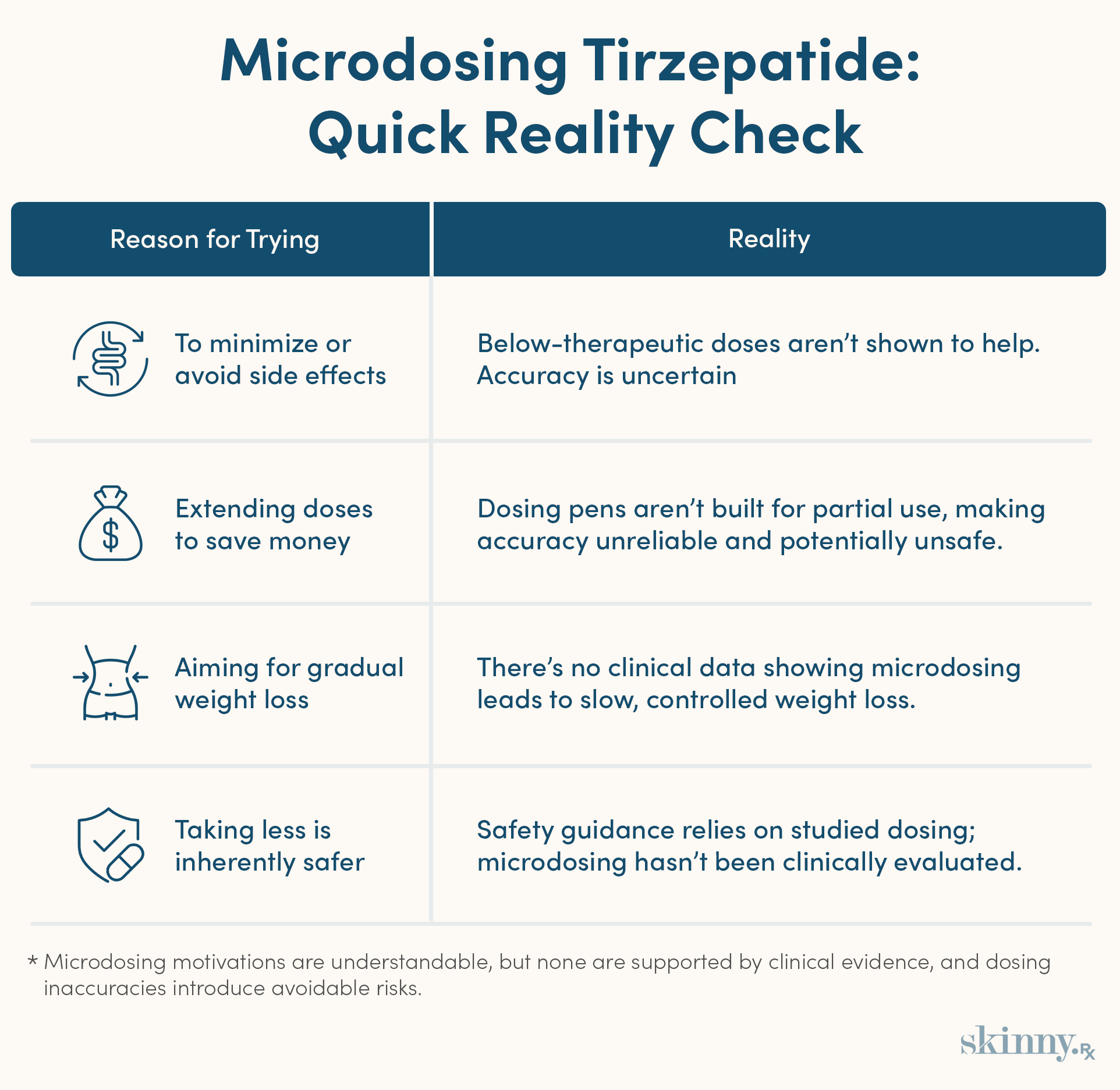
People who are highly wary of taking any medication, but who desperately want to make a change to their health status, might be drawn to microdosing tirzepatide.
Up front, it’s important to note that tirzepatide generally has mild side effects—mostly gastrointestinal. Still, anyone with a fear of vomiting or who struggles with stomach issues might think they can have their cake and eat it too by microdosing the medicine.
Easing Financial Burdens
More practically, microdosing tirzepatide may also be seen as a budget-stretching technique. For some, particularly those without insurance, this GLP-1 can seem expensive, with list prices of over a thousand dollars a month.
If you can’t significantly reduce the cost through insurance or other discounts, you might find your way to thinking you’ll just inject half as much, or half as often, thereby softening the blow to your wallet.
Seeking a Gentler Weight Loss Experience
Not everyone is in a rush to lose weight. Tirzepatide and semaglutide alike are known for their rapid weight loss, and dropping weight too quickly comes with its own drawbacks. Think muscle loss, or even malnutrition.
If you’re not in a hurry, microdosing might seem like a cheat code—a way to put your weight loss journey on the back burner, so you can slowly chip away at the scale over many months or even years.
While shrewd, there’s unfortunately no long-term data supporting the idea that microdosing tirzepatide facilitates slow, gradual weight loss. Even at higher doses, people tend to plateau in their weight loss efforts after 12+ months.
The Critical Lack of Scientific Evidence on Tirzepatide Microdosing
We’ve touched on it above, but it bears repeating: Microdosing tirzepatide has not been critically examined in a laboratory setting with human controlled trials. Sure, science has its limits. But since GLP-1s are still an emergent form of medicine, letting the science lead the way is absolutely paramount for safety.
Dosing recommendations for tirzepatide are based on rigorous, thorough clinical studies. Even in scholarly settings, researchers rely on these standardized dosing regimens to conduct other experiments.
What it means: There’s still so much to learn about how GLP-1s work, and what they can be used for. Pushing those frontiers forward requires a strong, reliable foundation, which is why most research on tirzepatide is conducted using dosages that we know have a meaningful effect.
Titration Schedules vs. Microdosing
That’s not to say that scientists never adjust the dose of tirzepatide. Titration schedules refer to the cadence at which a patient might ramp up their dose of a medication. Regarding tirzepatide, most people begin with the 2.5mg starter dose and increase after four weeks because clinicians have found that pace to be the best way to reach a therapeutic level while mitigating risk.
Microdosing is not the same thing as titration, which has a distinct starting point and a discrete goal. Microdosing is more improvisational and less accurate, which is why doctors generally advise against it.
Potential Risks of Microdosing Tirzepatide
Microdosing tirzepatide may not have much scientific merit at this time, but that doesn’t dissuade everyone. That said, both the American Diabetes Association and Cleveland Clinic strongly caution against it due to the risk factors involved.
Inconsistent Dosing Accuracy
Halving your weekly tirzepatide dose to make it last longer might sound good on paper, but in practice, you can’t be sure you’re doing it accurately.
As you've heard, tirzepatide is administered with injection pens. Proper protocol requires you to hold the injection button down, while the pen is firmly pressed against your skin, for up to 10 seconds or until you hear a distinct “click” signaling the dose has been completely administered.
“It is important to follow the injection and dosing protocols that have been studied and approved,” says Dr. Daniel McGee, D.O. “I have had patients end up in the hospital with uncontrolled vomiting by not following the proper dosing regimen. These guidelines are in place because they’ve been studied. They’re there for patient safety.”
Guessing how much you've injected and removing the pen before the second click is neither reliable nor safe for adjusting your dose. If your current dosage isn't working for you, the right step is to speak with your clinician about adjusting your prescription through proper medical channels.

For your own health and safety, it's important to follow the injection and dosing protocols that have been studied and approved. I have had patients tell me they have even dispensed the medication from their pen into a cup or jar at home, then keep that in the fridge and use small amounts intermittently by drawing that medication back into a syringe and needle they have gotten elsewhere to use. This kind of thing puts people at a huge risk and is completely uncontrolled. I have also had someone end up at the hospital with uncontrolled vomiting by not following the proper dosing regimen and taking too much medication too soon. All of these guidelines are in place because they have been studied, and they are there for patient safety.
–
Dr. Daniel McGee, Board-certified Family Medicine Physician
Sourcing Concerns
Compounding pharmacies, where tirzepatide is custom-made outside of FDA-approved protocols, can provide adjusted doses of GLP-1s.
Circumventing FDA approval raises concerns about sourcing. You can't be certain you're getting the exact dose you want, and the medicine may be diluted with other substances to reach that lower dose in the first place.
The FDA has sternly cautioned against seeking out compounded GLP-1s. If you are considering this route, thorough due diligence is essential. Verify that any compounding pharmacy is state-licensed, PCAB-accredited, and transparent about their preparation and testing processes.
Unforeseen Side Effects
All medications have side effects, determined after extensive testing at different dosage levels and in specific contexts. Intuitively, it might seem like taking less than the starting 2.5mg dose of tirzepatide couldn't possibly worsen the side effects, but outcomes outside of studied dosing protocols are not guaranteed.
More likely, though, are unforeseen side effects relating to the process itself. You're not meant to reuse injection pens or adjust doses outside of what was doctor-prescribed for you. Doing so exposes you to potential cross-contamination risks. And if you're going through a compounding pharmacy, you can't be certain the tirzepatide you receive was prepared under the sterile conditions required for injectable medications.
Professional Guidance: The Only Path Forward
Here’s the big picture: We don’t know that microdosing tirzepatide is necessarily dangerous, since there’s no good data on it. But we can’t confidently say it’s a good idea either—there’s no good data on it.
As with any medication, the best thing to do is rely on informed guidance from clinicians who have done the tedious, laborious work of putting these substances through the scientific wringer.
If you have concerns about tirzepatide’s side effects, or if you feel it is out of reach financially, talk to your doctor. There are other paths you can take than standing in your kitchen, pen in hand, telling yourself, “Okay, I’ll just eyeball half this week.”
Switch to a Brand 100,000+ Patients Trust
Doctor-reviewed GLP-1 care, no insurance and no office visits. As low as $99 for the first month.
Frequently Asked Questions

By Jake Dickson, NASM-CPT, USAW-L2
Contributing Author
Jake holds a B.S. in Exercise Science from UNC Wilmington and began his career as a personal trainer and weightlifting coach. In recent years, he’s moved behind the page as a writer and editor, contributing hundreds of articles and being featured as a subject matter expert. Today, Jake’s goal remains the same: to empower people to change their lives by bringing heady scientific topics down to ground level.