
 Medically Reviewed

Key Takeaways
- Progressive overload can help preserve muscle while you lose weight on a GLP-1.
- Up to 40% of weight loss on a GLP-1 can come from lean muscle, so make strength training a priority.
- If heavier lifts feel harder, you can still progress by adding reps, sets, range of motion, or slower tempo.
- Recovery depends on getting enough protein, sleep, and time between harder sessions.
- If fatigue, weakness, or appetite loss starts affecting daily life, talk to your healthcare provider.
If you’re using a GLP-1 medication to lose weight, you can’t let the drug do all the work. Why? Studies show that GLP-1 users may regain over 60% of the weight they lose once they come off the meds.
Lifestyle changes, especially adopting a consistent exercise routine, mitigate this risk. This is doubly true for strength training. Incorporating progressive overload on GLP-1s helps support long-term progress even after you stop taking the drug.
And doctors agree that good training habits become even more important after you stop your GLP-1:
The scale moving on a GLP-1 doesn't mean the gym becomes optional. If anything, that's exactly when strength training matters most,” says Daniel McGee, D.O. “This is something I bring up with every patient I start on a GLP-1, because of how important it is. The number on the scale gets all the attention, but I'm just as focused on what happens to their muscle mass along the way.”
Here’s what you need to know about progressive overload on GLP-1s.
What Is Progressive Overload?
Progressive overload is the mechanism that forces your body to adapt to increasing challenges. Over time, you gain strength and make a difficult task, such as picking a weight up off the ground, easier.
Here’s where things get tricky: The body doesn’t like wasteful adaptation. Once you’ve built the requisite muscle mass and coordination to lift, say, 100 pounds, there’s no reason for the body to adapt further—unless you give it something heavier to move.
In practice, progressive overload on GLP-1s works the same way no matter what your preferred type of exercise is. Runners run longer to build their lung capacity, yogis work toward more advanced poses, and weight lifters gradually move from lighter dumbbells to heavier ones.
Strength Training & Progressive Overload for GLP-1 Users
GLP-1 users should prioritize strength training because of its unique capacity to build and maintain muscle mass. Research tells us that up to 40% of weight lost during a GLP-1 protocol can come from lean muscle.
Muscle loss is more than an aesthetic issue. It’s a risk factor for injury and metabolic health, especially in older adults. Progressive overload offsets the risk of muscle loss by giving your body something to continually adapt to, signaling that existing muscle should stick around and new muscle should be built.

Lifestyle changes alone can't fully stop this rebound, most people gain significant weight after stopping GLP-1 medications, even with healthy habits. But strength training makes a real difference. Rapid weight loss, on medication or not, includes some muscle along with fat. Progressive overload training helps preserve that muscle, which is what keeps your metabolism running strong: the more muscle you have, the more calories you burn, even at rest.
–
Dr. Daniel McGee, Board-certified Family Medicine Physician
Why Strength Progress Can Feel Different on GLP-1s
GLP-1 medications can interfere with your ability to incorporate progressive overload. The drugs themselves aren’t the issue—it’s the side effects that make challenging exercise difficult for some users.
Broadly speaking, GLP-1s are appetite suppressants. They interact with the parts of your brain responsible for regulating cravings and also slow down your body’s digestive processes, helping you feel fuller longer.
These effects put users into a calorie deficit, encouraging the body to use up stored fat instead.
Prolonged calorie deficits are damaging to athletic performance. It’s difficult to hit the weights hard if you aren’t eating well. Fewer, smaller meals mean a lower caloric intake, plus potentially insufficient levels of carbohydrates, water, sodium, and other nutrients that support optimal physical performance.
You can still gain strength while on a GLP-1. Strength is a neural adaptation; it’s your central nervous system’s ability to recruit muscle fibers and create force.
But if you’ve been using a GLP-1 while following a strength training routine, it might feel difficult or even impossible to lift heavier weights. You might feel weak, sluggish, or unable to lift heavy due to the stomach-upsetting side effects of the drug.
Luckily, there are multiple ways to apply progressive overload during your workouts while on GLP-1 medications. Increasing your strength through lifting heavier weights isn’t the only avenue.
Weight Loss Options That Fit Your Goals
Start with an online assessment to see whether prescription weight loss treatment may fit your goals while you work to maintain strength.
Progressive Overload Without Adding Weight: How To Do It
Consistency is the most important factor for progress in an exercise routine, according to the American College of Sports Medicine’s 2026 position stand.
Whether you’re on a GLP-1 or not, you should perform progressive resistance training of some sort at least twice per week to maintain healthy levels of muscle tissue.
If adding weight feels impossible during your workouts, remember that progressive overload is about making the workouts harder. Lifting heavier is the most direct way of doing that, but it’s not the only strategy that works.
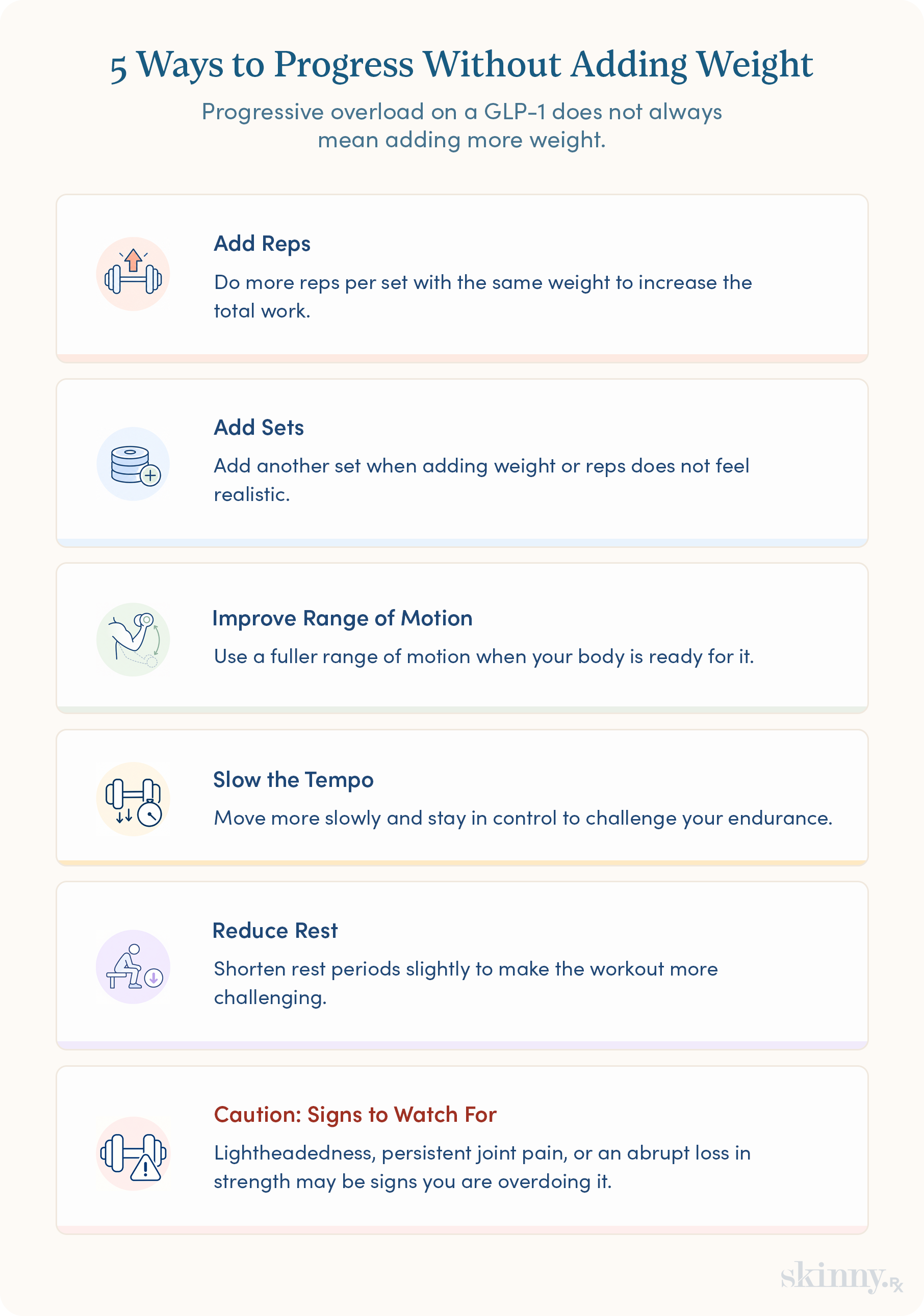
Add Reps
If you can’t add weight, try doing more reps during each set. Think of it like this—if you can bench press 100 pounds for five reps one week, and six reps the next week, you’ve moved more weight around overall. That’s progressive overload in action.
A good rule of thumb to follow is that once you’ve added five or more repetitions from where you started, reset back to your original rep count but with a slightly heavier weight.
Add Sets
If adding reps isn’t possible, do another set. Increasing your volume—that’s the total workload you perform in the gym—over time is a primary driver of long-term progress.
Studies show that strength has a dose-response relationship with volume; the more you do, the stronger you get.
But there are significant diminishing returns, too. If you typically do two sets of an exercise in a workout, gradually work up to five. You should be able to drop back to two or three sets with a heavier weight at that point.
Improve Range of Motion
Adding range of motion counts as progressive overload because you’re exposing your muscles to stress at different tissue lengths. Squatting all the way down instead of halfway down is more difficult because your quadriceps and glutes stretch further the deeper you go.
Be conservative about pushing range of motion. Don’t force your body into positions it isn’t ready to handle. Be discerning about what’s uncomfortable and what’s painful.
Slow the Tempo
Slowing your tempo, or movement speed, makes the exercise harder as well. You have to maintain control for a longer period of time, challenging your endurance.
Slow-tempo training is also a great way to dial in your exercise form on movements with complex techniques like squats and deadlifts.
Reduce Rest
Reducing rest periods increases the density of your training, or how much work you accomplish in a given period of time. If you typically rest for two minutes between sets, try limiting yourself to a minute and forty-five seconds instead.
Bear in mind that this form of progressive overload begins to cross over into cardiovascular training if you rest too briefly.
Recovery Rules When Appetite is Lower
Recovery during strength training is essential because that’s when the progress actually materializes, not during the workout itself. Here’s the tricky part for GLP-1 users: effective recovery depends on proper nutrition, which becomes much more difficult if your appetite is diminished.
If you’re using a GLP-1 medication for weight loss, you can’t really force yourself into a caloric surplus. However, you can ensure you’re optimizing recovery by…
- Prioritize protein at every meal. Protein is essential for sparing muscle tissue, and some data suggest eating above 1g per pound of bodyweight is helpful.
- Sleep consistently and sufficiently. If you’re not able to eat enough to maximize recovery, making your sleep hygiene airtight is one of the few levers you can pull that makes a difference.
- Space out sessions: Back-to-back days of hard training take a toll, even if you’re hitting different muscle groups. Take rest days after two workout days in a row to give your body time to adapt.
When To Back Off or Get Help
Progressive overload is not an essential component of resistance training. Doing the same workouts over time is not wasted energy, it’s consistent—that’s the most important factor.
Whether you’re using a GLP-1 medication or not, there will be times when you simply don’t have the means to keep pushing yourself.
There are tell-tale signs of overdoing it; lightheadedness, persistent joint pain, or abrupt losses in strength are yellow flags worth paying attention to. An injury is a red flag. If fatigue, weakness, or appetite loss is severe enough to interfere with daily activities (not just your workouts), talk to your healthcare provider.
If you aren’t sure how to navigate progressive overload on a GLP-1, seek a qualified personal trainer or coach with experience working with clients in similar situations.
The Bottom Line
A GLP-1 can help you lose weight, but it can’t protect your muscle for you. Strength training can help, and progressive overload gives your body a reason to hold on to the muscle you have. If heavier lifts feel out of reach, you can add reps, add sets, improve your range of motion, slow your tempo, or reduce your rest.
Strength train at least twice per week, prioritize protein at every meal, and sleep consistently so your body has time to recover. And if you can’t keep progressing, repeating the same workout still counts.
Staying consistent is more important than forcing progress every session. If fatigue, weakness, or appetite loss starts interfering with daily activities, talk to your healthcare provider.
Weight-Loss Care With Ongoing Support
Access prescription treatment, provider guidance, and helpful tools built around your progress, all in one app.
Frequently Asked Questions

By Jake Dickson, NASM-CPT, USAW-L2
Contributing Author
Jake holds a B.S. in Exercise Science from UNC Wilmington and began his career as a personal trainer and weightlifting coach. In recent years, he’s moved behind the page as a writer and editor, contributing hundreds of articles and being featured as a subject matter expert. Today, Jake’s goal remains the same: to empower people to change their lives by bringing heady scientific topics down to ground level.