

 Medically Reviewed

Key Takeaways
- GLP-1 medications reduce food noise by signaling fullness and lowering hunger at the brain level.
- Changes in the brain’s reward system reduce the intensity of cravings and the urge to act on food-related thoughts.
- Effects on multiple brain regions work together to shift how hunger, satiety, and food cues are processed.
- Emerging research suggests that GLP-1s may influence baseline brain activity associated with persistent food thoughts.
- Reduced food noise reflects biological changes rather than willpower, helping explain more consistent control over eating behavior.
If you've started a GLP-1 medication and suddenly found your mind remarkably quiet, you’re not alone.
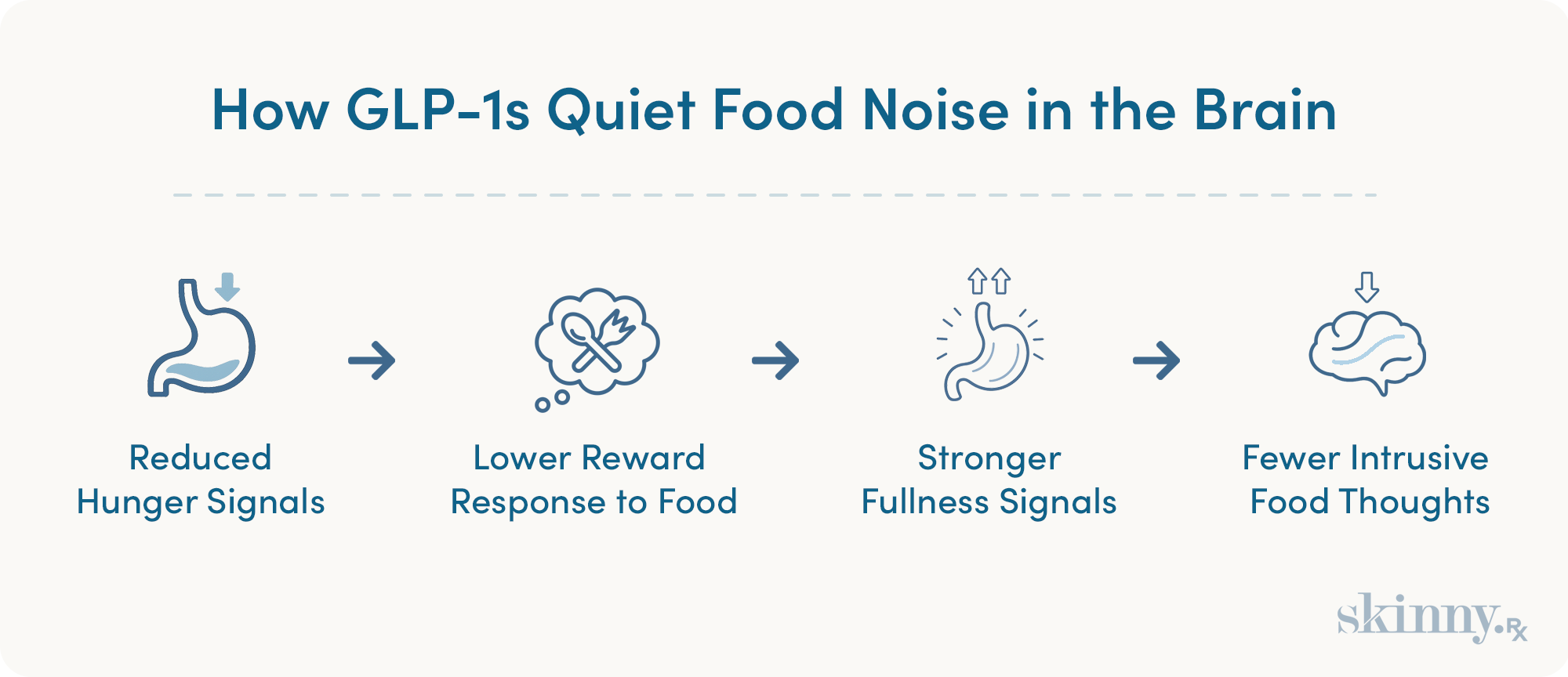
Various research shows that not only can these medications help you lose weight by slowing down digestion, but they also support weight loss at the brain level. GLP-1s like semaglutide work on the brain’s reward system, boosting satiety and quieting food noise and cravings.
Here’s a closer look at what’s happening in your brain and what you can realistically expect.
What is "Food Noise" Really? (It’s Not Just Hunger)
"Food noise" refers to intrusive, persistent, and vivid thoughts about eating, which you may have even when you’re not hungry. You might be constantly thinking about what or when you’ll eat next, how much you are or “should” be eating, or guilt about what you just ate or didn’t eat. Think of it as steady background noise about food — hence, “food noise.”
It’s normal to experience food noise from time to time. In fact, sometimes the food noise you hear is your brain telling you you need to eat. But usually when people talk about food noise, they’re describing the unhelpful kind characterized by incessant thoughts about food.

See If GLP-1 Treatment Is Right for You
Take a quick assessment to see if doctor-guided GLP-1 treatment is right for you. Get a personalized plan based on your goals and medical history.
The Mental Load of Constant Negotiation
To get an idea of how disruptive food noise can be, imagine your mind as a radio. At all times, there’s a radio station playing static at full volume in the background. You can try to ignore it, but the constant negotiation is exhausting as your brain peppers you with questions like: Did you eat too much? Should you have eaten something healthier? When will you eat next?
Then, you start taking semaglutide, and suddenly that station is a whole lot quieter. But semaglutide doesn't just seem to turn the radio down. It feels like it changes the frequency so you can finally hear other things — like your hobbies, your work, and your family.
The Three-Pronged Attack: How GLP-1s Rewire the Brain
So, why do you stop thinking about food on Ozempic®? It resets your brain’s relationship with food through its interactions with various parts of your brain.
1. The Hypothalamus: Turning Off the “Hunger Alarm”
Your hypothalamus is an unassuming, almond-sized structure in your brain that plays a major role in regulating your appetite. Its goal is to keep your energy intake stable, based on inputs from appetite hormones like ghrelin and leptin.
When we talked about food noise being normal sometimes, like when you’re actually hungry, that’s the hypothalamus talking. It essentially regulates your “stomach hunger” or “homeostatic hunger.” If your stomach is getting low on food, appetite hormones tell your hypothalamus you need to eat more to keep your body stable.
But, GLP-1s like semaglutide also talk to your hypothalamus. By sending “satiety” or “fullness” signals to your hypothalamus, they turn off the hunger alarm.
As a result, the urgency to eat — along with the accompanying food noise — diminishes.
2. The Mesolimbic System: Lowering the Reward Volume
If the hypothalamus regulates the homeostatic “stomach hunger” that tells you your body needs fuel, you can think of the mesolimbic system as driving your hedonic “brain hunger.”
The mesolimbic system includes the ventral tegmental area (VTA) and nucleus accumbens (NAc). Simply put, it’s the brain’s reward center. That dopamine hit you’re chasing when you crave certain foods — when your “food noise” feels the loudest — is driven by the mesolimbic system.
Semaglutide quiets food noise by putting a damper on dopamine spikes in these areas, effectively telling your brain to pay less attention to food cues. As a result, a passing thought about a donut no longer triggers an overwhelming urge to consume it.
3. The Hindbrain: Strengthening the “I'm Full” Signal
Finally, semaglutide communicates with GLP-1 receptors in the hindbrain to amplify satiety signals and feelings of fullness. Through this coordinated approach on various parts of your brain — the hypothalamus, mesolimbic system, and hindbrain — semaglutide quiets food noise, resulting in effects like:
- Feeling more in control over how much you eat
- Having less intense cravings for sweet and savory foods
- Craving dairy, high-fat, and savory foods less often
- Having a lower appetite in general
- Experiencing fewer episodes of binge eating or emotional eating
The 2026 Breakthrough: The Default Mode Network (DMN)
Preliminary 2026 research suggests yet another way GLP-1s quiet food noise by rewiring the brain’s default mode network (DMN).
The DMN takes over when we’re not actively working on a specific task, like having a conversation or doing our taxes. It’s at its most active at times when our mind is at rest but awake, such as when we’re daydreaming.
Why Your Brain “Daydreams” About Food
When you aren't actively focusing, your brain shifts into the DMN to drive internally oriented thoughts, like daydreaming or envisioning the future. In people living with obesity, this default state often fixates relentlessly on food.
Routine cues — like feeling slightly stressed or seeing a fast-food sign — trigger the DMN into what researchers call a “maladaptive” craving loop. Your brain repeatedly focuses on short-term rewards (the food) at the expense of your long-term goals (weight loss).
How Semaglutide Stabilizes Background Brain Activity
While more research is needed, it appears that GLP-1s like semaglutide may rebalance the DMN, especially when it comes to food noise.
Specifically, neuroimaging suggests that GLP-1s may help repave the connections your brain has made between food cues and the reward it expects. As a result, when your mind wanders on semaglutide, it doesn't automatically wander straight to the pantry.
The resulting mental silence gives your brain the mental space it needs to support your weight loss goals. For example, instead of fighting against a food-obsessed DMN, you can practice mindful eating — enjoying and savoring the food in front of you.
This mindfulness practice can help reinforce your new healthy habits by encouraging your mind to stay present when it comes to food, instead of ruminating on the past or the future.
Why “Willpower” Was Never the Answer
For years, the conversation around weight loss was dominated by a single, exhausting word: willpower. Drugs like GLP-1 are finally changing that conversation.

For years, patients were told their struggle with food was a willpower problem. What we’re now seeing with GLP-1s is that it was often a signal problem. When the brain’s hunger and reward pathways quiet down, patients aren’t fighting themselves all day, and that changes everything.
–
Dr. Sajad Zalzala, MD, SkinnyRx Medical Director
The Biology of Cue-Reactivity
Before GLP-1s, patients were told to simply ignore their food noise — a nearly impossible task when your neurobiology is wired to hyper-fixate on them. What’s more, research shows that attempting to suppress food noise only leads to more cravings and binge eating.
Thankfully, weight loss medications like Wegovy® are helping tune out that food noise at a brain level. People taking it still enjoy food, but they don’t think about it all the time.
The question is: does semaglutide have these effects only while you’re taking the drug, or is it making positive long-term changes in your brain?
Recent research from Penn Medicine suggests the effect may be temporary, but their case study only involved one person. More researchers are currently looking into whether semaglutide’s effects on dopamine may make these medications effective at treating other conditions, such as alcohol and substance abuse.
Start Your Personalized Weight Loss Plan
Take a quick assessment to see if doctor-guided GLP-1 treatment is right for you. Get a personalized weight loss plan based on your health and history.
“Is It Working?” Signs Your Food Noise Is Fading
You'll know your food noise is fading when you can walk past a plate of cookies without mental debate, or when you realize it's 2:00 PM and you haven't planned your dinner yet.
This shift happens due to the way GLP-1 receptor agonists interact with key areas of the brain to regulate hunger signaling. By quieting these signals, these medications can help free up precious mental real estate. That space is finally yours again. You are in control, not your food noise.
When to Consider Medical Guidance
Whether you’re just starting to explore GLP-1 treatment or already noticing changes, speaking with a licensed clinician can help clarify what a structured, guided approach may look like for you.
A provider can evaluate your health history, goals, and treatment response to determine what options are appropriate and how to use them safely.
At SkinnyRx, this starts with a short assessment designed to match you with a clinician who can guide your next steps and provide ongoing support as your needs evolve.
Frequently Asked Questions

By Amelia Willson
Contributing Author
Amelia Willson is a freelance health writer and content strategist based in Orange County, California. Her work has appeared in several health publications, including Ro, Klarity Health, K Health, Sleep Foundation, and A Place For Mom. Amelia covers the latest trends in health and wellness, including the research (or lack thereof) behind them, breaking down complex topics so that readers don't have to. Her writing frequently explores weight management, plant-based nutrition, and mental health.