
 Medically Reviewed

Key Takeaways
- GLP-1 medications reduce “food noise” by dampening dopamine-driven cravings, helping separate true hunger from impulse-driven eating, and creating more control around food choices.
- By lowering the reward value of food, GLP-1s can support consistent calorie intake and sustainable weight loss without constant mental preoccupation.
- This same dopamine shift can make food and other reward-driven behaviors feel less satisfying, which some users experience as a temporary “muted” feeling.
- Reduced interest in eating can lead to undereating if not managed, making adequate nutrition and protein intake important to protect muscle and overall health.
- Rebalancing reward pathways by prioritizing exercise, social interaction, and creative activities can help maintain mood, reinforce healthy habits, and improve long-term outcomes on GLP-1s.
It’s hard to deny the life-changing potential of GLP-1 medications, both as a tool for managing diabetes and facilitating weight loss. But what if you’re making progress on your GLP-1 medication and feel more disconnected than ever?
It’s not all in your head—technically. GLP-1s act on your brain to reduce cravings, but in the process, may potentially also dampen feelings of excitement or enthusiasm.
We’re going to break down the neurological impact of GLP-1s on your brain’s reward systems and simplify the science behind why you might feel a bit disconnected from things that used to bring you joy.
Your Brain on GLP-1s
For many users, GLP-1RAs, or glucagon-like peptide-1 receptor agonists, do a lot more than just curb cravings or curtail erratic blood glucose. Folks on semaglutide or tirzepatide for weight loss often describe a newfound mental serenity; fewer impulses, cravings, and fixations, often described as “food noise.”
It’s important to note that food noise isn’t the same thing as hunger. A 2023 narrative review described food noise as “rumination and obsessive preoccupation about food,” even when not actively hungry—something which GLP-1s seem to help suppress, according to what we currently know.
What causes the food noise to begin with? Dopamine. Or, more specifically, an insatiable need for it.
What Is a Dopamine Loop?
Dopamine is one of your brain’s neurotransmitters. Put simply, dopamine relays signals across different areas of the brain, rewarding biologically advantageous behaviors like experiencing sensory pleasure or getting enough food, sex, or rest.
Elevated dopamine feels good, but you can have too much of a good thing and become desensitized to it, gradually requiring higher doses, more frequently, to achieve the same effect. That’s a dopamine loop.
Research tells us that overweight or obese individuals “might have impairments in dopaminergic pathways … associated with reward sensitivity,” leading to food noise: Eating decadent food prompts a dopamine surge, so you feel compelled to eat even when you aren’t hungry to get your “fix.”
Satiety vs. Pleasure
This mental conflation between eating for biological satiety (meeting your body’s actual needs) and pleasure (the dopamine surge from consuming tasty food) is at the heart of how GLP-1s seem to quiet the storm.
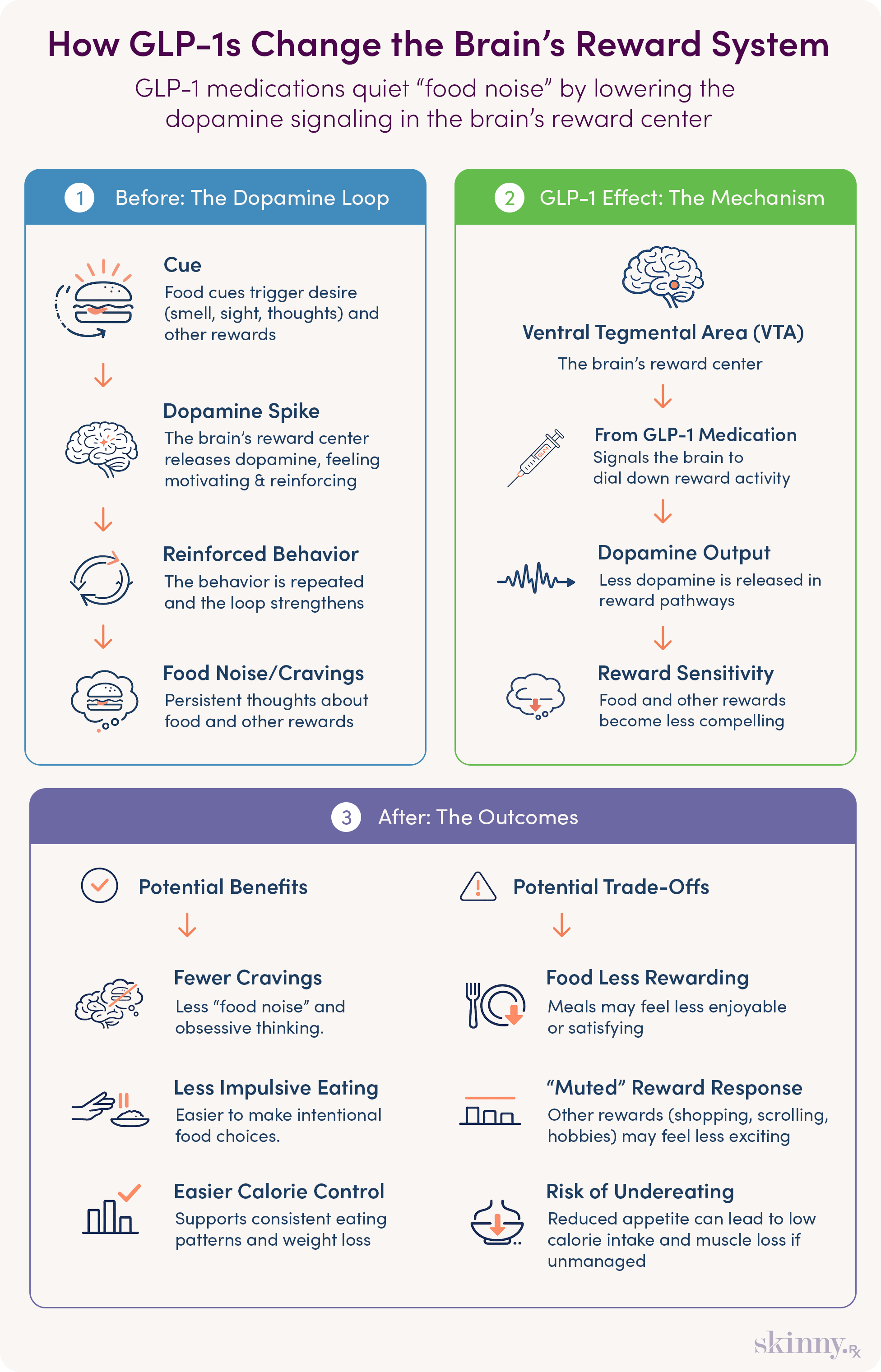
There’s a region in your brain called the VTA—the ventral tegmental area. Think of it as a central hub in your reward-processing circuitry. Studies indicate that GLP-1s activate inhibitory neurons in the VTA, which, in turn, suppress dopamine activity.
By dampening the VTA, GLP-1s subtly influence you to eat less by making it seem less rewarding to eat, even when you’re not hungry. The front-facing outcome? Sustained, significant weight loss. But there are side effects, too.
The “Muted” Life
If you’re losing weight on a GLP-1, you might feel like life has gradually become muted. Things which used to bring you joy, food included, are sapped of their color and pleasure. If you’ve always had a healthy relationship with food, this can be hard to grasp. But losing food joy can feel like losing a friend, even if it’s technically “healthy.”
An indistinct relationship with food is consistently observed in long-term GLP-1 users. Some scholars have noted how the drugs “consistently reduced … eating behavior triggered by appetizing smells, the visual appeal of food, or observing others eat.”
Why the GLP-1 Dopamine Shift Can Be Dangerous
At a glance, uncoupling your reward circuitry from food seems like a no-brainer when you’re trying to lose weight. After all, impulsive or unstructured snacking is the bane of any dieter’s existence.
The “muted” experience of GLP-1 appetite suppression is a good thing taken too far. Muscle loss on semaglutide or tirzepatide is a relevant concern here—if you eat too little, you risk cannibalizing your lean muscle mass alongside body fat, which has a host of negative downstream consequences.
And if food brings you no joy to eat, it’s all too easy to skip out altogether and put yourself in too deep of a caloric deficit. If that sounds familiar, you may need to “reset” your dopamine wiring.
Weight Loss That Finally Sticks
GLP-1 weight loss medications do more than suppress appetite — they rewire how your brain responds to food. Get a doctor-prescribed, custom-tailored weight loss plan designed around your health goals.
Resetting Dopamine on GLP-1s
Here’s the thing: Your brain is complicated, and it’s smarter than you (don’t think too hard about that, it gets existential fast). Changing your neurochemical landscape isn’t a quick fix, and may not be something you can consciously control to begin with.
That said, it is wise to give yourself some mental breathing room by breaking the dopamine-chasing cycle associated with food. In plain English? Find joy in, and train your brain to feel rewarded by, other things.
Creative Hobbies
Resetting your dopamine while on GLP-1s is all about finding other sources of pleasure. With less time thinking about your next meal, you have some mental real estate to devote to creative, effort-based pastimes instead.
A study conducted by Drexel University’s College of Nursing & Health Professions in 2017 looked at how creative pursuits, like making art, affect your brain’s reward pathways. They found that creative hobbies have an “inherent potential for evoking positive emotions,” regardless of skill level.
Exercise
You shouldn’t let your GLP-1 do all the heavy lifting for you—literally. Studies consistently show that an exercise routine, specifically one that includes resistance training, improves weight-loss outcomes for those taking a GLP-1 and offers additional health benefits.
When it comes to the brain, sticking to an exercise routine long-term is about the best you can do. A 2021 systematic review of long-term studies found “robust effects of physical exercise on dopamine” persisting across the lifespan. To consistently elevate your baseline mood, exercise is second-to-none.
Want to scratch your dopamine itch immediately? Ask a runner. The “runner’s high” phenomenon describes an acute, noticeable elevation in mood after a bout of physical exertion—due to, researchers have found, “immediate changes in dopamine.”
Exercising hits two birds with the same stone: It provides long-term quality of life insurance, while also accelerating your weight loss on GLP-1s.
It’s worth noting that you can become addicted to the dopamine surge from exercise the same way you can with food, so it’s best to adopt a structured, scheduled routine rather than hit the treadmill every time you’re feeling even slightly upset.
Socializing
Being more social can also help reset your brain’s reward systems. Positive chemical interactions are what reinforce human interaction—spend time with those whose company you enjoy, or whom you care deeply for, and your brain rewards you.
The issue? Many social settings are based around food. If you have no issue resisting temptation on a GLP-1, this may not be a hindrance. But if you’re dealing with complicated feelings around cravings, it might be smart to look for new social avenues, like group classes or book clubs.
Cold Plunging & Contrast Therapy
Ice baths and saunas are hogging the limelight in the health & wellness industry. There’s a lot of hype on the Internet’s airwaves about the myriad health benefits of cold water immersion in particular, including that it may provide a “dopamine shock.”
This idea has some merit. Some research has shown how, “After cold water immersion, swimmers reported elevated positive emotions … associated with [neural coupling] between brain areas.”
Taking an icy dip does seem to provide a gentle shock to your system, but this “happy jolt” is temporary. Long-term benefits are much murkier. After just 24 hours following cold water immersion, some data have shown mood levels unchanged from pre-bath baseline.
The Big Picture
Eating is a fundamental human behavior. It’s spurred by a vast neurochemical web of interactions. When thrown into chaos, it’s easy to succumb to the relentless fixation on food in order to feel better—even, and especially, when you’re not hungry.
GLP-1s help you fight those urges, but at the cost of draining food of its flavor and texture. If you feel muted on your GLP-1, it might be worth investigating other ways to recalibrate your relationship with dopamine.
Weight Loss That Finally Sticks
GLP-1 weight loss medications do more than suppress appetite — they rewire how your brain responds to food. Get a doctor-prescribed, custom-tailored weight loss plan designed around your health goals.
Frequently Asked Questions

By Jake Dickson, NASM-CPT, USAW-L2
Contributing Author
Jake holds a B.S. in Exercise Science from UNC Wilmington and began his career as a personal trainer and weightlifting coach. In recent years, he’s moved behind the page as a writer and editor, contributing hundreds of articles and being featured as a subject matter expert. Today, Jake’s goal remains the same: to empower people to change their lives by bringing heady scientific topics down to ground level.