
 Medically Reviewed

Key Takeaways
- Wegovy is FDA-approved for adults with MASH who have moderate-to-advanced liver fibrosis but do not have cirrhosis.
- The approval does not apply to MASLD or other forms of fatty liver disease that do not meet those criteria.
- In clinical trials, 62.9% of patients taking semaglutide experienced MASH resolution without worsening fibrosis, compared with 34.3% taking a placebo.
- People with a personal or family history of medullary thyroid cancer or multiple endocrine neoplasia should not take Wegovy.
- A liver specialist can review your diagnosis, fibrosis stage, and overall liver health to determine whether Wegovy may be appropriate.
While Wegovy is commonly known as a weight loss medication, the injection offers other potential benefits as well. Another FDA-approved use of Wegovy is to treat metabolic dysfunction–associated steatohepatitis (MASH). MASH is a more progressive form of fatty liver disease that’s characterized by liver inflammation, damage, and possibly scarring. Wegovy may help reverse MASH, but only for patients who meet certain criteria.
Continue reading to learn more about Wegovy's MASH approval, including when this treatment may be appropriate, the nuances of the FDA’s guidelines, and questions to ask your doctor if considering Wegovy for a fatty liver.
What Are MASLD and MASH?
In short, metabolic dysfunction-associated steatotic liver disease (MASLD) occurs when there’s fat buildup in the liver. Metabolic dysfunction-associated steatohepatitis (MASH) is a more severe form of MASLD. It’s marked by inflammation, damage, and sometimes scarring.
To better understand these two conditions, let’s take it back to anatomy 101. Today’s topic: the liver, which is one of the body’s largest organs. It plays a role in digesting food, storing energy, and removing toxins from the body. There are many different types of liver conditions, and most are caused by excessive alcohol consumption, viral hepatitis, or a nonalcoholic fatty liver.
Both MASLD and MASH stem from a fatty liver without excessive alcohol consumption. While the exact cause of nonalcoholic fatty liver disease is unknown, there are established risk factors. These include:
- Type 2 diabetes
- Obesity
- Middle-aged or older
- High blood pressure
- High levels of cholesterol in the blood
- Specific metabolic disorders, including metabolic syndrome
- Prediabetes
These risk factors apply to both MASLD and MASH. That’s because both are different stages of nonalcoholic fatty liver disease:
- MASLD: The early stages of fat buildup in the liver (that’s not caused by alcohol consumption). It’s estimated that 38% of adults have MASLD.
- MASH: Previously called nonalcoholic steatohepatitis or NASH, this is a more severe form of MASLD. To diagnose MASH, there must be liver inflammation and damage.
MASLD is harder to detect since it’s asymptomatic. If it progresses to MASH, symptoms may include fatigue, abdominal pain, severe itching, fluid buildup in the belly or ankles, and jaundice (yellowing of the skin or eyes).
MASH typically leads to scarring in the liver as well. There are two types of scarring a healthcare provider will look out for: fibrosis and cirrhosis. Fibrosis occurs when scar tissue forms within the liver. Cirrhosis is a more severe, permanent form of fibrosis. It can lead to serious complications, such as liver failure or liver cancer.
What Did the FDA Approve?
Wegovy was initially FDA-approved for reducing the risk of major cardiovascular events and for weight loss. In August of 2025, the FDA issued an accelerated approval of this weight loss medication for the treatment of MASH if cirrhosis was not present and there was moderate-to-severe fibrosis. This type of approval is based on short-term improvements, with data on long-term outcomes expected to arrive around 2029.
The FDA added the MASH approval based on results from the phase three ESSENCE trial. In this trial, patients with noncirrhotic MASH and moderate-to-severe fibrosis took 2.4mg of semaglutide weekly. They experienced significant improvement, leading the researchers to suggest that semaglutide may have an effect on MASH.
More specifically, 62.9% of the study participants in the semaglutide group experienced MASH resolution, the disappearance of liver inflammation, and their fibrosis did not worsen. In comparison, only 34.3% of participants receiving the placebo experienced the same effects.
Additionally, semaglutide may improve overall digestion, with a 2026 narrative review suggesting it promotes diversity in the gut microbiome for people with MASH. A small 2026 randomized clinical trial also found that participants who took semaglutide lost weight, including a meaningful reduction of fat in the liver. Both a stronger gut microbiome and the loss of fat in and around the liver may contribute to the reversal of MASH.
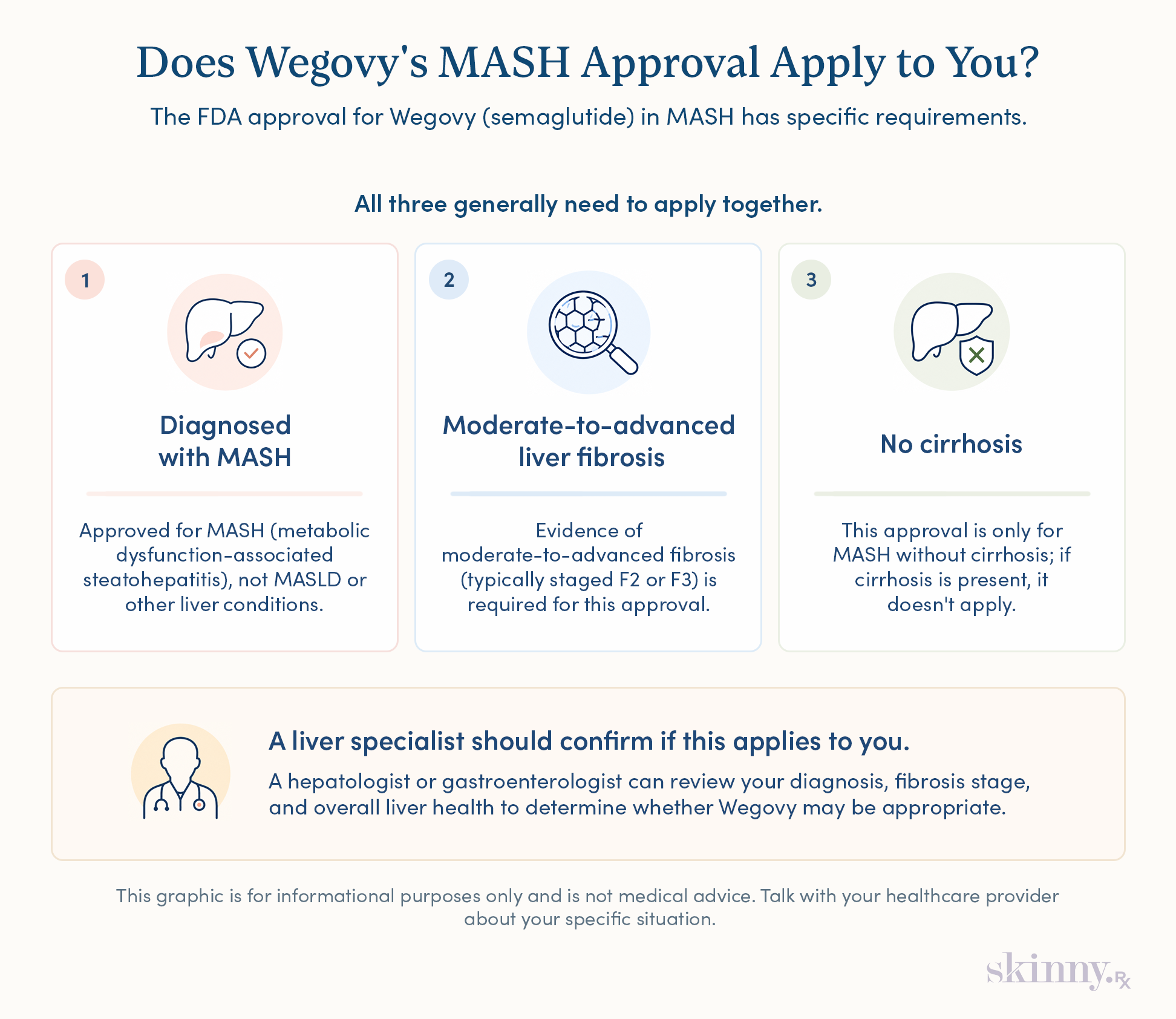
Important Note: The FDA approval of Wegovy is not for every person with fatty liver disease. It applies to adults with noncirrhotic MASH with moderate-to-advanced liver fibrosis.
Weight-Loss Care With Ongoing Support
Access prescription treatment, provider guidance, and helpful tools built around your progress, all in one app.
Who the Approval Applies To
The FDA approval does not mean Wegovy is a suitable option for everyone with a fatty liver. It is approved specifically for MASH, not for MASLD or other types of liver disease. To be a suitable candidate, someone must also have non-cirrhotic MASH, meaning there is no permanent scarring in the liver. MASH must also be accompanied by moderate-to-advanced fibrosis.
There are also more general safety guidelines for Wegovy. This medication is contraindicated for people with a personal or family history of medullary thyroid cancer, multiple endocrine neoplasia, or a known sensitivity to semaglutide.
A qualified healthcare provider, such as a hepatologist (liver specialist) or gastroenterologist (digestive tract specialist), can help determine if Wegovy is a suitable option on a case-by-case basis.
What Moderate-to-Advanced Fibrosis Means
Liver fibrosis refers to scarring in the liver that may be reversed, while cirrhosis is permanent scarring. Healthcare providers determine scarring progression in distinct stages:
- Stage 0: No scarring
- Stage 1: Minimal fibrosis, defined in three substages depending on severity by healthcare providers
- Stage 2: Moderate fibrosis with some scar tissue
- Stage 3: Bridging fibrosis, a more advanced stage where septa, or bands of scar tissue, are present
- Stage 4: Cirrhosis
F2 or F3 is typically defined as moderate-to-advanced fibrosis. Among people with MASH or with certain conditions that often occur alongside MASH, moderate-to-advanced fibrosis is relatively common. The American Diabetes Association, for example, estimates that one out of every six people with type 2 diabetes has moderate-to-advanced liver fibrosis.
Limitations of Wegovy for Fatty Liver Disease
Semaglutide is not appropriate for all cases of fatty liver disease. It’s currently only approved for nonalcoholic fatty liver disease that meets the following criteria:
- Progressed to MASH
- Moderate or severe fibrosis is detected
- No cirrhosis is present
Sometimes, semaglutide may be prescribed for another reason, such as weight loss, in patients with cirrhosis. When this is the case, a healthcare provider will carefully monitor cirrhosis and overall liver functioning. Many healthcare providers monitor this with non-invasive fibrosis tests, like FIB-4, elastography, or liver enzymes.
In some case studies, patients with MASH and cirrhosis who took semaglutide experienced liver decompensation, which is when the body can no longer cope with scarring.
Even for those who meet the above criteria, Wegovy’s effect is limited. A 2025 meta-review of 22 randomized clinical trials cautioned that Wegovy may reverse MASH, but any regression in fibrosis was limited.
Questions to Ask Your Liver Specialist or Clinician
While semaglutide can help in some cases of MASH, only a healthcare provider who examines an individual patient can determine if it’s an appropriate treatment for them.
If interested in Wegovy for MASH, here are a few questions to ask a provider at your next appointment:
- Have I been diagnosed with MASLD, MASH, or another liver condition?
- Do I have fibrosis? If so, what stage is it at?
- Do I have cirrhosis?
- What tests or imaging have been used to evaluate my liver?
- Would a GLP-1 medication be appropriate given my medical history?
- How will liver health be monitored over time?
A healthcare provider will answer these questions based on the results of any liver tests, a thorough examination of the patient’s liver, and their overall medical history. If Wegovy isn’t an appropriate option, they can prescribe a different treatment.
Bottom Line
Wegovy’s approval for MASH is an important development, but it is not a treatment for every person with fatty liver disease.
It is approved specifically for adults with noncirrhotic MASH and moderate-to-advanced fibrosis. The ESSENCE trial showed encouraging results for MASH resolution, but the evidence for reversing liver fibrosis remains limited.
If you have MASLD, MASH, or another liver condition, a hepatologist or gastroenterologist can review your diagnosis, fibrosis stage, and overall liver health to determine whether Wegovy or another treatment approach may be appropriate.
Frequently Asked Questions

By Angela Myers
Contributing Author
Angela Myers is a freelance health writer covering weight management, healthy aging, and nutrition. Her work has appeared in AARP, Well+Good, and Forbes, among others. Before starting her writing career, she conducted award-winning research on how to improve sexual violence prevention courses on college campuses. That research sparked a passion for health communication, and she's been writing about making healthcare accessible and inclusive ever since.